

Refurbish Vs Replace: Which Is Better For Your Industrial Metal Components?
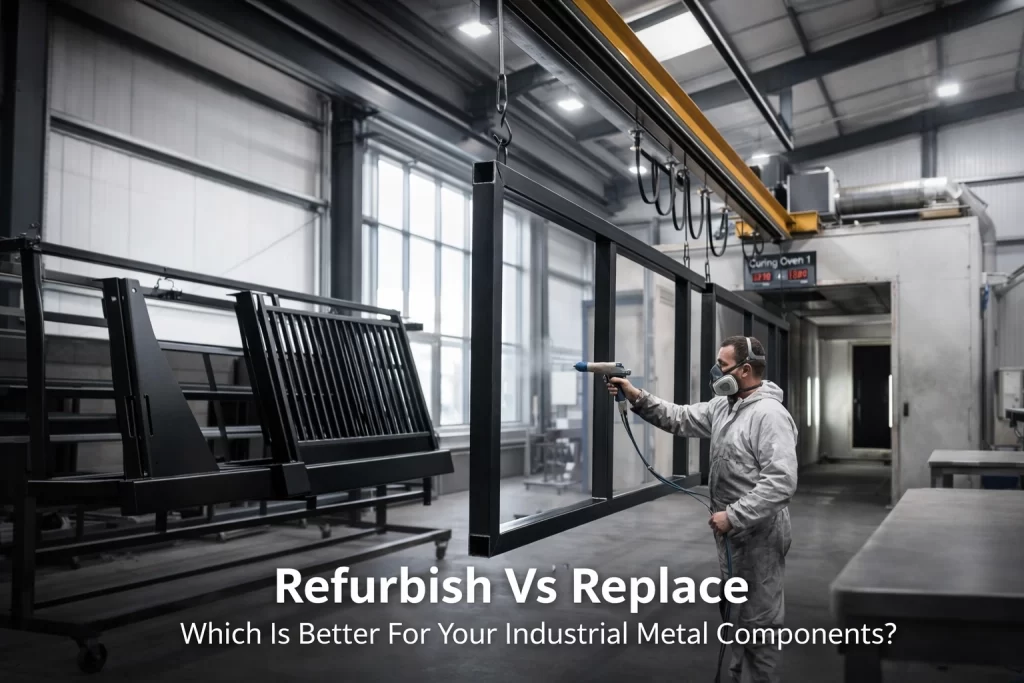
Refurbishing metal components through shot blasting and powder coating is typically 40–60% cheaper than replacing them with new, and a professionally refinished item can last another 15–25 years. However, replacement is the only option when the metal has structural damage, has rusted through, or no longer meets current safety standards.
This guide compares the two options on cost, durability, turnaround and environmental impact, and gives a clear framework for deciding which is right for your project.
Key Takeaways
- Refurbishing is typically 40–60% cheaper than replacement
- A powder coated refurbishment lasts 15–25 years outdoors
- Refurbishment turnaround is usually 2–5 days; replacement can take weeks due to manufacturing and lead times
- Refurbishing reuses up to 80% of the original material, reducing waste and carbon impact (source: WRAP — Waste and Resources Action Programme)
- Replace if the metal has rusted through, is structurally compromised, or no longer meets current regulations
- If refurbishment costs more than 60% of the replacement price, replacing is usually the better long-term decision
When Should You Refurbish Metal Components Instead of Replacing Them?
Refurbishment is the better choice when the metal itself is structurally sound but the surface finish has deteriorated. Rust, flaking paint, faded colour, surface corrosion and general weathering are all finish problems — not structural problems. If the metal underneath is still solid, stripping it back and applying a new powder coating gives it a factory-quality finish at a fraction of the replacement cost.
Refurbishment makes sense when:
- The metal is structurally intact — surface rust and old coatings can be removed by shot blasting, exposing clean, solid metal underneath
- The item is still fit for purpose — it does the job it was designed to do; only the finish has failed
- Replacement would be expensive or disruptive — new fabrication costs, lead times, delivery, removal of old items and installation all add up
- The item has heritage or aesthetic value — cast iron railings, period gates, decorative metalwork and architectural features are worth preserving rather than replacing with modern alternatives
- Budget is limited — refurbishment delivers a like-new result at 40–60% of the replacement cost

How Much Does It Cost to Refurbish Metal vs Replace It?
The table below compares typical UK costs for refurbishing (shot blasting + powder coating) versus replacing common metal items:
| Item | Refurbish Cost | Replace Cost | Saving |
|---|---|---|---|
| Pair of garden gates | £80–£150 | £300–£800 | 50–80% |
| Metal railing (per metre) | £15–£30 | £60–£120 | 70–75% |
| Set of 4 garden chairs | £60–£120 | £200–£500 | 60–75% |
| Cast iron radiator | £40–£70 | £200–£400 | 65–80% |
| Industrial guard/enclosure | £40–£150 | £150–£500 | 60–70% |
| Balustrade section (per metre) | £20–£40 | £80–£200 | 70–80% |
| Fire surround (cast iron) | £60–£120 | £300–£600 | 70–80% |
| Staircase railing (full) | £150–£300 | £500–£1,500 | 70–80% |
Refurbishment prices include shot blasting, surface preparation and powder coating in a single RAL colour. Replacement prices include the cost of a new item plus basic fitting.
For an exact refurbishment quote, contact Spraytech with photos and dimensions of your items
How Does the Metal Refurbishment Process Work?
The refurbishment process follows five stages:
1. Assessment — We inspect the item to assess the metal condition, identify any structural issues (cracks, holes, thinning) and determine whether it is suitable for refurbishment. If the metal is structurally compromised, we will advise replacement.
2. Stripping — Old paint, rust, mill scale and previous coatings are removed by shot blasting with steel grit. This strips the item back to bare metal and creates a clean surface profile for the new coating to bond to.
3. Repair (if needed) — Minor surface damage, small rust pits and weld imperfections can be ground smooth or filled before coating. This is only cosmetic repair — structural damage cannot be safely repaired by coating.
4. Pre-treatment — The bare metal is treated with iron phosphate (for mild steel) or chromate-free conversion coating (for aluminium) to create a corrosion-resistant base layer beneath the powder coat.
5. Powder coating and curing — The item is powder coated in the specified RAL colour and cured in our ovens at 180–200°C. The result is a hard, durable finish that looks and performs like new — lasting 15–25 years outdoors.
Most domestic refurbishment jobs are completed within 2–5 working days.

Is a Refurbished Metal Component as Durable as a New One?
Yes — in most cases a professionally refurbished component is as durable as new, and in some cases more so. The reason is that refurbishment includes a level of surface preparation that many new items do not receive.
New fabricated steel often arrives from the manufacturer with only a basic primer coat applied over mill scale. Mill scale is a loosely bonded iron oxide layer that will eventually flake, taking the primer with it. Many “new” items begin to show rust within 2–3 years because the mill scale was never removed.
A refurbished item, by contrast, is shot blasted back to bare metal (removing all mill scale), chemically pre-treated, and then powder coated. This preparation is more thorough than most factory finishes, which is why a professionally refurbished item can match or exceed the coating lifespan of a new equivalent.
| Factor | New Item (Factory Finish) | Refurbished (Shot Blast + Powder Coat) |
|---|---|---|
| Surface preparation | Basic primer over mill scale | Full shot blast to Sa 2½ + pre-treatment |
| Coating type | Often wet paint or basic powder | Polyester powder coat (specified) |
| Expected coating life | 5–10 years (factory paint) | 15–25 years (professional powder coat) |
| Colour choice | Limited to manufacturer’s range | Any RAL colour |
| Cost | Full replacement price | 40–60% of replacement |
When Should You Replace Instead of Refurbish?
Replacement is the right choice when refurbishment cannot restore the item to a safe, functional condition:
The metal has rusted through — Surface rust is cosmetic and can be blasted off. Rust that has eaten through the metal wall thickness is structural damage. A gate with holes in it, a railing with paper-thin sections, or a beam with significant cross-section loss cannot be safely refurbished — the metal itself is compromised.
The item is structurally cracked or bent — Cracks in load-bearing metalwork (staircases, balustrades, structural supports) are a safety risk. Powder coating covers cracks cosmetically but does nothing to restore structural strength.
It no longer meets current regulations — Building regulations, fire ratings and safety standards change over time. If the existing metalwork does not meet current codes, refurbishing the finish does not solve the compliance issue — the item needs to be replaced with one that meets the current standard.
Refurbishment cost exceeds 60% of replacement — If the item is severely damaged and requires extensive welding, fabrication repair and coating, the total cost may approach or exceed the cost of a new item. At that point, replacement gives you a new item with a full lifespan ahead of it.

What Are the Environmental Benefits of Refurbishing Metal?
Refurbishing metal instead of replacing it has a significant environmental benefit. According to WRAP (Waste and Resources Action Programme), remanufacturing and refurbishing products can save up to 80% of the raw materials and significantly reduce the energy and carbon emissions associated with producing new items.
When you refurbish:
- No new raw material is needed — the existing steel or aluminium is reused in place
- No manufacturing energy — smelting, rolling and fabricating new steel is one of the most energy-intensive industrial processes
- No transport emissions — new items are often shipped from overseas; refurbishment is done locally
- No landfill waste — the old item stays in use instead of being scrapped
- Powder coating is near-zero VOC — no solvents, overspray is recycled, less than 5% material waste
For construction contractors and architects working towards BREEAM or sustainability targets, specifying refurbishment over replacement contributes directly to materials and waste reduction credits.

What Items Can Be Refurbished by Powder Coating?
We regularly refurbish:
- Gates, railings and fencing — the most common domestic refurbishment; old paint and rust stripped, new colour applied
- Garden furniture — cast iron and steel tables, chairs, benches restored to like-new condition
- Cast iron radiators — period radiators blasted and coated for use in renovated properties
- Fire surrounds — Victorian and Edwardian cast iron surrounds cleaned and refinished
- Architectural metalwork — balustrades, staircases, window frames and heritage features
- Industrial components — machine guards, enclosures, frames and equipment housings
- Automotive parts — alloy wheels, chassis components, brackets and subframes
- Steel fabrications — structural sections, beams, brackets and site metalwork
If you are unsure whether your item can be refurbished, send us photos and we will assess the condition and advise. Contact Spraytech →
Frequently Asked Questions
Is it worth refurbishing old metal gates and railings?
In most cases, yes. If the metalwork is structurally sound — no holes, no cracks, no severe thinning — then shot blasting and powder coating will restore it to a like-new condition for 40–60% of the cost of new gates. A refurbished pair of garden gates costs £80–£150 and will last another 15–25 years.
How do you know if metal is too far gone to refurbish?
We inspect every item before quoting. If shot blasting reveals that the metal has rusted through (holes, paper-thin sections) or has structural cracks, we will advise that the item needs replacing rather than coating. We will not coat structurally compromised metalwork because the coating cannot restore strength.
How long metal refurbishment take?
A: In most cases, yes. If the metalwork is structurally sound — no holes, no cracks, no severe thinning — then shot blasting and powder coating will restore it to a like-new condition for 40–60% of the cost of new gates. A refurbished pair of garden gates costs £80–£150 and will last another 15–25 years.
How do you know if metal is too far gone to refurbish?
Most domestic items are completed within 2–5 working days, including stripping, preparation and coating. Larger items or heavily rusted components may take a few days longer. Industrial and batch refurbishment is scheduled based on volume and turnaround requirements.
Is refurbished metalwork as strong as new?
The metal itself does not lose strength through refurbishment — shot blasting removes surface contamination, not base material. The new powder coating is typically more durable than the original factory finish because the preparation is more thorough. However, if the metal has already lost cross-section to deep rust, the remaining metal is thinner and therefore weaker — this is when replacement is needed.
Do you collect and deliver items for refurbishment?
Yes. We arrange collection and delivery across Hertfordshire, Essex, London and the wider South East. Drop-off is also welcome at either of our Bishop’s Stortford facilities during working hours.
Can aluminium items be refurbished the same way?
Yes, but aluminium requires different preparation. We use aluminium oxide media for blasting (never steel grit) and apply a chromate-free conversion coating instead of iron phosphate. The powder coating process is the same — electrostatic application and oven curing at 180–200°C.
Conclusion
Refurbishing metal through shot blasting and powder coating is cheaper, faster and more environmentally responsible than replacing in most situations. A refurbished item costs 40–60% less than new, lasts 15–25 years and reuses the original material with near-zero waste. Replace only when the metal is structurally compromised or no longer meets current standards.
At Spraytech, we provide metal refurbishment for domestic, industrial and architectural metalwork from two facilities in Bishop’s Stortford, serving London, Hertfordshire, Essex and the South East.