

Is Powder Coating Good for Alloy Wheels? Pros, Cons and Cost
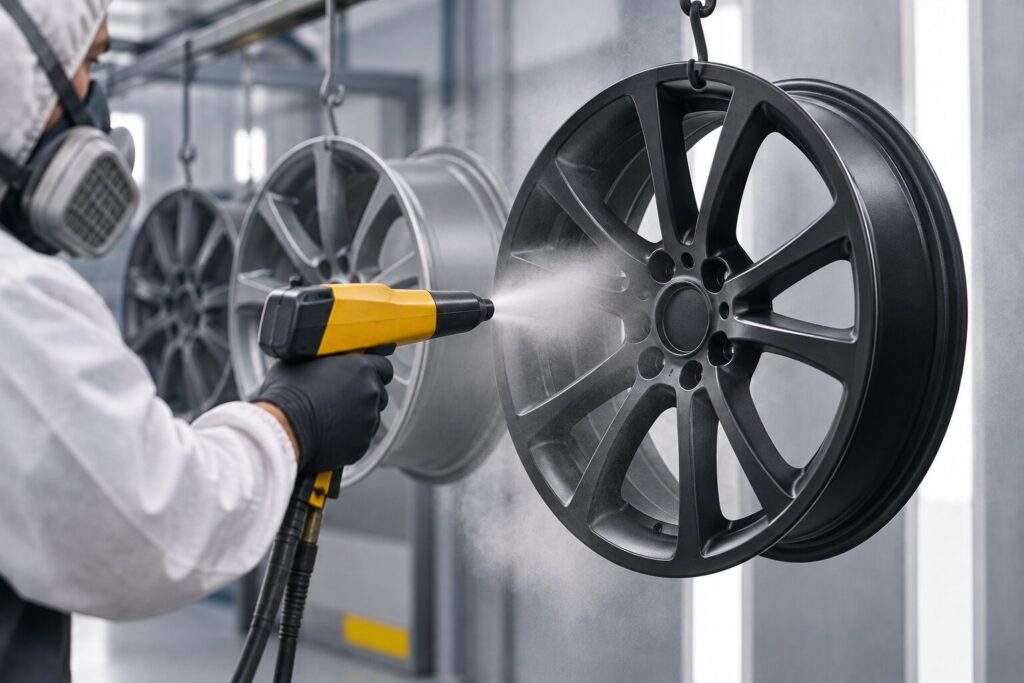
Alloy wheel powder coating is one of the most durable ways to refinish or change the colour of your wheels. It produces a harder, more chip-resistant finish than wet paint, lasts significantly longer, and is available in hundreds of colours and finishes. However, it is not the cheapest option and requires the tyres to be removed before coating.
This guide covers how the process works, what it costs in the UK, the pros and cons compared to painting, and what to look for when choosing a powder coater for your wheels.
Key Takeaways
- Alloy wheel powder coating typically costs £40–£70 per wheel in the UK, or £160–£280 for a full set of four
- A powder coated finish lasts 5–10 years on wheels, compared to 1–3 years for standard wheel paint
- Powder coating is more resistant to stone chips, brake dust, road salt and kerb damage than paint
- Tyres must be removed before powder coating because the curing oven reaches 180–200°C
- Powder coating releases near-zero VOCs, making it more environmentally friendly than solvent-based wheel paints (source: UK VOC Regulations 2012)
What Is Alloy Wheel Powder Coating?
Alloy wheel powder coating is the process of applying a dry polyester powder to an alloy wheel using an electrostatic spray gun, then curing it in an oven at 180–200°C to form a hard, durable finish. The result is a factory-quality coating that is significantly more resistant to chipping, scratching, fading and corrosion than conventional wheel paint.
The process requires the tyre to be removed from the wheel before coating, because the curing oven temperature would destroy the tyre rubber. The wheel is then shot blasted or chemically stripped to remove the old finish, pre-treated, powder coated and cured. Once cooled, the tyre is refitted and the wheel is ready to go back on the car.
Alloy wheel powder coating is suitable for most standard alloy wheels, including OEM wheels, aftermarket wheels and classic car wheels. It is used both for refurbishment (restoring a damaged or tired finish) and for customisation (changing the colour or finish type).
How Is Alloy Wheel Powder Coating Done?
The process follows six stages. Each stage affects the quality and durability of the finished wheel.
H3: Step 1 — Tyre Removal
The tyre is removed from the wheel. This is essential because the curing oven operates at 180–200°C — far above the temperature a tyre can withstand. The tyre valve is also removed at this stage.
H3: Step 2 — Stripping the Old Finish
The existing paint, lacquer or powder coating is removed. This is done by shot blasting with aluminium oxide media (never steel grit, which would contaminate the aluminium) or by chemical stripping. Any kerb damage, corrosion or pitting is assessed at this point.
H3: Step 3 — Repair (If Needed)
Kerb damage, scratches and minor corrosion can be filled and smoothed before coating. Deep cracks or structural damage cannot be safely repaired — wheels with structural damage should be replaced, not coated.
H3: Step 4 — Pre-Treatment
The bare aluminium wheel is treated with a chromate-free conversion coating. This removes the natural aluminium oxide layer and replaces it with a controlled conversion layer that promotes powder adhesion and prevents corrosion beneath the finish.
H3: Step 5 — Powder Coating Application
The powder is applied electrostatically. The charged powder particles adhere evenly to the grounded wheel, including into spoke recesses and around bolt holes. Multiple coats can be applied for special finishes (e.g. a base colour plus a clear coat for a metallic or gloss effect).
H3: Step 6 — Curing and Inspection
The wheel is cured in an oven at 180–200°C for 15–20 minutes. After cooling, the finish is inspected for coverage, thickness, colour accuracy and freedom from defects. The tyre is then refitted and balanced.
How Much Does Alloy Wheel Powder Coating Cost in the UK?
Alloy wheel powder coating costs vary depending on wheel size, condition, the number of coats required and the finish specified. Typical UK prices:
| Service | Price Per Wheel | Set of 4 |
|---|---|---|
| Standard single-colour powder coat (up to 18″) | £40–£60 | £160–£240 |
| Standard single-colour powder coat (19″–22″) | £55–£75 | £220–£300 |
| Two-tone or split finish | £65–£90 | £260–£360 |
| Diamond-cut face with powder coated barrel | £75–£100 | £300–£400 |
| Hyperblack / satin black | £45–£65 | £180–£260 |
These prices typically include tyre removal and refitting, stripping, pre-treatment, coating and balancing. Wheels with heavy kerb damage or corrosion may cost more due to additional preparation.
For an exact quote, contact Spraytech with photos of your wheels and the finish you want.
What Are the Pros and Cons of Alloy Wheel Powder Coating?
| Powder Coating | Wet Paint | |
|---|---|---|
| Durability | 5–10 years | 1–3 years |
| Chip resistance | Excellent — hard, thick coating | Moderate — thinner, softer film |
| Stone chip protection | High | Low to moderate |
| Brake dust resistance | Good — smooth finish is easier to clean | Moderate — porous finishes trap dust |
| Colour range | 200+ RAL colours, metallics, textures | Unlimited custom mixing |
| Finish quality | Factory-level, consistent | Can be very good but technique-dependent |
| Environmental impact | Near-zero VOCs | High VOCs (solvent-based) |
| Cost per wheel | £40–£70 | £25–£45 |
| Tyre removal required? | Yes (oven curing at 200°C) | No (can be masked) |
| Turnaround time | 2–5 days (tyres off/on) | 1–3 days |
| Recoatability | Must be stripped first | Can be sanded and resprayed |
Pros of Alloy Wheel Powder Coating
- Far more durable — a powder coated wheel finish lasts 3–5 times longer than paint
- Better chip and scratch resistance — the cured coating is harder and thicker than paint (60–120 microns vs 25–50 microns)
- Superior corrosion protection — the sealed coating prevents moisture, road salt and brake fluid from reaching the aluminium
- Consistent, factory-quality finish — electrostatic application produces an even coat without runs, drips or brush marks
- Environmentally friendly — no solvents, near-zero VOCs, overspray powder can be recycled
Cons of Alloy Wheel Powder Coating
- Higher upfront cost — roughly 50–70% more expensive per wheel than wet paint, though the longer lifespan means lower cost per year
- Tyres must be removed — adds time and cost to the process; painting can be done with tyres on (masked)
- Harder to touch up — a stone chip on a powder coated wheel cannot be touched up with a brush; the wheel must be stripped and recoated for a perfect repair
- Not suitable for all finishes — some effects (candy colours, certain metallic flakes) are easier to achieve with wet paint
- Heat exposure — the 200°C curing temperature is safe for standard alloy wheels but not suitable for wheels with bonded plastic inserts or integrated TPMS sensors that cannot be removed
What Colours and Finishes Are Available?
Alloy wheel powder coating is available in the full RAL colour range — over 200 standard colours — plus specialist wheel finishes:
- Gloss black — the most popular choice for a clean, modern look
- Satin black / hyperblack — a darker, less reflective finish popular on performance and luxury cars
- Gunmetal grey — a metallic dark grey that works on most car colours
- Silver / OEM match — restoring wheels to their original factory colour
- Gloss white — bold contrast on dark cars
- Custom RAL colours — any colour from the RAL Classic or RAL Design range
- Textured finishes — fine or coarse texture for a non-standard look
- Two-tone — different colours on the face and barrel of the wheel
If you want a colour match to your car’s body or an exact OEM wheel colour, we can source or mix the correct powder. Send us a photo or RAL reference with your quote request.
How Long Does Powder Coating Last on Alloy Wheels?
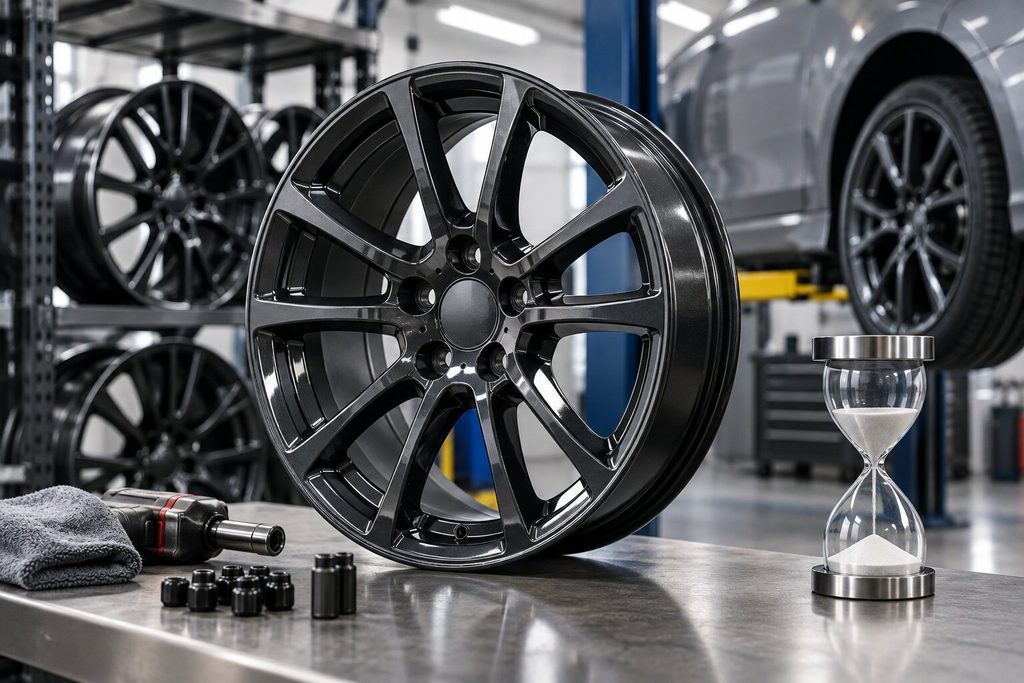
A correctly applied polyester powder coating on alloy wheels typically lasts 5 to 10 years before visible degradation, depending on driving conditions, road surface quality and how well the wheels are maintained. This compares to 1 to 3 years for standard wheel paint, which chips and peels much more quickly under road use.
The lifespan depends on:
- Driving environment — motorway driving with stone chips, salted winter roads and frequent kerbing will shorten the life of any wheel finish
- Cleaning habits — regular washing with a pH-neutral wheel cleaner removes brake dust and road salt before they can degrade the coating. Avoid acidic wheel cleaners, which can attack the powder coat surface
- Quality of preparation — wheels that were properly stripped, blasted and pre-treated before coating will last significantly longer than wheels coated over old paint or inadequate preparation
- Coating system — a two-coat system (colour plus clear coat) provides better protection than a single colour coat, particularly on lighter colours that show damage more easily
Frequently Asked Questions
Is powder coating better than painting alloy wheels?
For durability, yes. Powder coating produces a harder, thicker finish that lasts 5–10 years compared to 1–3 years for paint. It is more resistant to stone chips, brake dust, road salt and kerbing. However, painting is cheaper upfront and can be done without removing the tyres, so it may suit budget-conscious or short-term refurbishments.
Do tyres need to be removed for powder coating?
Yes. The curing oven operates at 180–200°C, which would destroy the tyre rubber. The tyre must be removed before coating and refitted afterward. This adds to the cost and turnaround time but is unavoidable with powder coating.
Can kerb damage be repaired before powder coating?
Minor kerb damage, scratches and light corrosion can be filled and smoothed before coating. However, deep gouges, cracks or structural damage to the wheel cannot be safely repaired. Wheels with structural damage should be replaced rather than refinished.
Can you powder coat diamond-cut wheels?
Diamond-cut wheels have a machined, lathe-cut face with a lacquered finish. The barrel and back of the wheel can be powder coated, but the diamond-cut face itself is produced on a CNC lathe, not by powder coating. If the diamond-cut face is damaged, it needs to be re-cut on a lathe and then re-lacquered. We can powder coat the barrel and spokes while the face is re-cut separately.
How long does alloy wheel powder coating take?
Most sets of four wheels are completed within 3 to 5 working days, including tyre removal, stripping, preparation, coating, curing and tyre refitting. Single wheels or urgent jobs can sometimes be turned around faster. Contact us to check current availability.
Will powder coating affect wheel balance?
Powder coating adds a very small amount of weight to the wheel (the coating is typically 60–120 microns thick), but this is evenly distributed and does not affect balance in any noticeable way. Wheels are re-balanced after the tyre is refitted.
Can I powder coat my wheels myself?
Powder coating requires specialist equipment — an electrostatic spray gun, a curing oven large enough to fit a wheel, and proper surface preparation facilities. It is not a DIY process. For a durable, professional result, alloy wheel powder coating should be done by an experienced coater with the right equipment.
Conclusion
Alloy wheel powder coating is the most durable way to refinish or customise your wheels. It costs more upfront than painting, but the finish lasts 3–5 times longer and handles the punishment of daily driving far better. If you want a finish that still looks good after 5+ years of road salt, stone chips and brake dust, powder coating is the right choice.
Spraytech provides domestic powder coating for alloy wheels, gates, railings, furniture and all types of household metalwork from our two facilities in Bishop’s Stortford — 30 minutes from London via the M11.