

Sustainable Metal Finishing: Changing Design in 2026
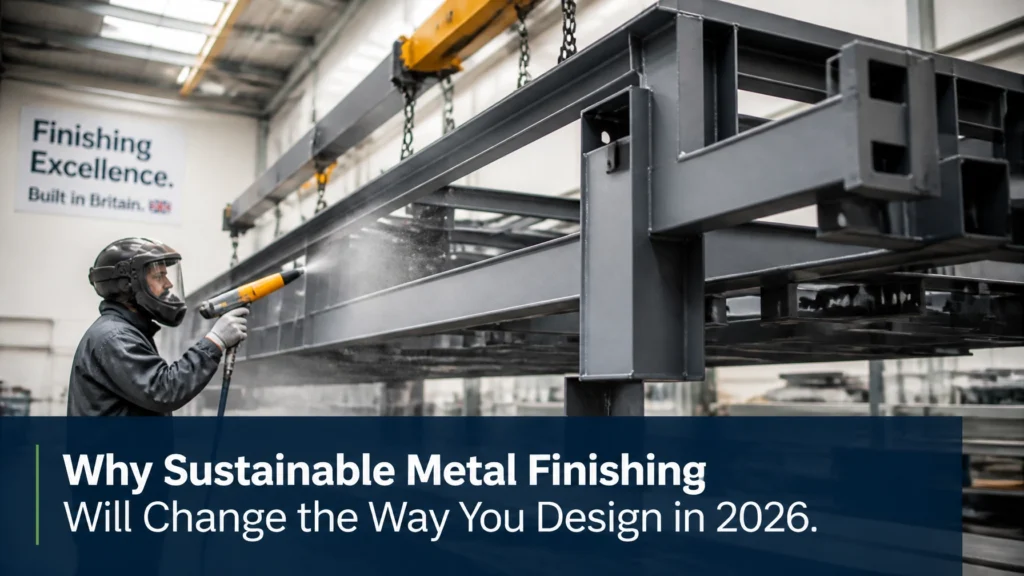
Sustainable metal finishing refers to coating processes that minimise environmental impact through reduced chemical emissions, lower material waste and longer-lasting finishes that reduce the need for recoating. Powder coating is the most widely used sustainable metal finishing method in the UK — it releases near-zero volatile organic compounds (VOCs), wastes less than 5% of material through recyclable overspray, and produces finishes that last 15–25 years outdoors.
This guide explains what makes a metal finishing process sustainable, how powder coating compares to traditional paint on environmental measures, and what it means for architects, contractors and manufacturers specifying finishes in 2026.
Key Takeaways
- Powder coating releases near-zero VOCs, compared to 300–500 g/l for conventional solvent-based paints (source: UK VOC Regulations 2012)
- Overspray powder is collected and reused, keeping material waste below 5% — wet paint systems typically waste 30–50% through overspray
- A powder coated finish lasts 15–25 years outdoors, reducing recoating frequency by 5–10x compared to paint
- Powder coating contains no solvents, no heavy metals and no hazardous air pollutants
- Sustainable finishing contributes to BREEAM, LEED and Considerate Constructors credits on UK construction projects
What Is Sustainable Metal Finishing?
Sustainable metal finishing is any coating or treatment process designed to protect metal while minimising harm to the environment, reducing waste and extending the lifespan of the finished product. In practical terms, a sustainable finishing process should meet three criteria: low or zero emissions during application, minimal material waste, and a durable result that does not need frequent replacement or recoating.
Powder coating meets all three. Unlike liquid paint, which relies on chemical solvents that evaporate as VOCs during drying, powder coating is a dry process — the powder is applied electrostatically and cured in an oven at 180–200°C with no solvents involved. Any overspray is collected, filtered and fed back into the system for reuse.
Traditional wet paint systems release between 300 and 500 grams of VOCs per litre, depending on the formulation. Powder coating releases effectively zero. This is why the finishing industry, construction specifiers and environmental regulators increasingly treat powder coating as the default sustainable choice for industrial, architectural and domestic metalwork.

How Does Powder Coating Reduce Environmental Impact?
Powder coating reduces environmental impact at every stage of the finishing process — from application through to end-of-life. Here is how it compares to traditional wet paint:
| Environmental Factor | Powder Coating | Wet Paint |
|---|---|---|
| VOC emissions | Near zero | 300–500 g/l (solvent-based) |
| Material waste | Under 5% (overspray recycled) | 30–50% (overspray lost) |
| Hazardous waste | None | Solvent waste requires specialist disposal |
| Coating lifespan (outdoor) | 15–25 years | 2–5 years |
| Recoating frequency | Once in 15–25 years | Every 2–5 years |
| Energy use (per m²) | Moderate (oven curing) | Lower (air drying) but offset by recoating |
| Lifecycle carbon | Lower (fewer recoats over building life) | Higher (repeated application + disposal) |
The energy used in oven curing is the one area where powder coating has a higher immediate footprint than air-dried paint. However, when measured over the full lifecycle of a building or structure, the carbon cost of curing once is far lower than the carbon cost of repainting every 3–5 years for the next 25 years — including the transport, preparation, application and waste disposal each time.
Why Does Sustainable Finishing Matter for Construction Projects?
Sustainable metal finishing matters for construction because finishing choices directly affect a project’s environmental certifications, long-term maintenance costs and compliance with tightening UK regulations.
BREEAM and LEED credits — Powder coating contributes to materials credits in both BREEAM (the UK’s most widely used building sustainability assessment) and LEED. Its low-emission profile supports indoor air quality credits, and its long lifespan supports lifecycle assessment (LCA) scores. Specifying powder coating over wet paint on architectural metalwork can contribute directly to a project’s sustainability rating.
Reduced maintenance over building life — A building with powder coated balustrades, cladding, gates and railings will not need those elements refinished for 15–25 years. The same elements painted with wet paint will need recoating every 3–5 years — generating repeated costs, disruption and waste over the building’s life.
Regulatory direction — The UK’s VOC Regulations 2012 already limit VOC content in paints and coatings. As regulations tighten further, powder coating’s zero-VOC profile positions it as the most future-proof finishing choice for construction contractors and architects.

What Makes Spraytech’s Process Sustainable?
At Spraytech, sustainability is built into the way we operate — not as a marketing claim but as a practical consequence of how powder coating works and how we run our facilities.
Zero-VOC application — Every item we coat is finished using dry powder with no solvents. Our spray booths are enclosed and extracted, with overspray collected for reuse. There are no solvent fumes, no hazardous vapour extraction and no chemical waste from the coating process.
Less than 5% material waste — Overspray powder that does not adhere to the workpiece is captured by our booth filtration system and fed back into the powder supply. Only powder that has been contaminated (e.g. mixed colours during a colour change) is disposed of, and even this is non-hazardous waste.
Surface preparation without chemicals — For mild steel items, we use shot blasting rather than chemical stripping wherever possible. Shot blasting is a mechanical process — steel grit is fired at the surface to remove rust and old coatings. The spent grit is collected, filtered and reused. No acids, no solvents, no chemical waste.
Long-lasting finishes that reduce recoating — Our polyester powder coatings last 15–25 years on external metalwork. By extending the time between recoats, we directly reduce the total materials, energy, transport and waste generated over the life of the coated item.
Local facilities, shorter transport — Our two facilities in Bishop’s Stortford are 30 minutes from London via the M11. For projects across Hertfordshire, Essex and London, this means shorter transport distances for collection and delivery — reducing the carbon footprint of the finishing stage compared to shipping items across the country.
Which Metals Can Be Sustainably Powder Coated?
Powder coating can be applied to any conductive metal that withstands oven temperatures of 180–200°C. The most commonly coated metals are:
- Mild steel — structural steelwork, fabricated components, gates, railings, fencing
- Aluminium — architectural cladding, curtain walling, window frames, louvres
- Galvanised steel — items pre-treated with zinc for additional corrosion resistance
- Cast iron — radiators, heritage components, decorative metalwork
Each material receives a specific pre-treatment process — iron phosphate for steel, chromate-free conversion coating for aluminium — to ensure the coating bonds correctly and lasts as long as possible. Proper preparation is the single biggest factor in coating longevity, which is why shot blasting is included as standard on all Spraytech jobs where it is required.
For wood-based components such as MDF panels and joinery, we offer a separate spray finishing service using low-VOC water-based coatings.

Frequently Asked Questions
What is sustainable metal finishing?
Sustainable metal finishing refers to coating processes that minimise environmental impact through low or zero chemical emissions, reduced material waste and long-lasting results. Powder coating is the most common example — it releases near-zero VOCs, recycles overspray and produces finishes lasting 15–25 years, reducing the need for repeated recoating.
Is powder coating eco-friendly?
Yes. Powder coating is one of the most environmentally friendly metal finishing methods available. It contains no solvents, releases near-zero volatile organic compounds (VOCs) and wastes less than 5% of material. By comparison, solvent-based wet paint releases 300–500 g/l of VOCs and wastes 30–50% of material through overspray that cannot be recovered.
Does powder coating help with BREEAM or LEED certification?
Yes. Powder coating’s zero-VOC profile contributes to indoor air quality credits in both BREEAM and LEED assessments. Its long lifespan also supports lifecycle assessment (LCA) scores by reducing the frequency of maintenance, recoating and material replacement over the building’s life.
How long does a sustainable powder coating finish last?
A correctly applied polyester powder coating typically lasts 15–25 years on external metalwork before visible degradation. Super durable polyester systems can extend this further. This compares to 2–5 years for standard wet paint, meaning powder coating requires 5–10 times fewer recoats over a building’s lifetime.
Is powder coating better for the environment than painting?
On every key environmental measure, yes. Powder coating produces zero VOCs (vs 300–500 g/l for solvent paint), wastes under 5% of material (vs 30–50% for paint), generates no hazardous solvent waste, and lasts 5–10 times longer — reducing the total lifecycle environmental impact by a significant margin.
Can sustainable powder coating handle large industrial projects?
Yes. Spraytech operates six ovens with up to 10 metres of capacity across two facilities in Bishop’s Stortford. We handle large structural steel sections, high-volume batch production and phased delivery programmes for industrial and architectural projects across London and the South East.
What UK regulations cover VOC emissions in coatings?
The main regulation is the Volatile Organic Compounds in Paints, Varnishes and Vehicle Refinishing Products Regulations 2012, which sets maximum VOC content limits for coatings sold in the UK. Powder coating falls well within these limits as it contains effectively zero VOCs. The regulations are enforced by the Department for Environment, Food and Rural Affairs (Defra).
Conclusion
Sustainable metal finishing is not a trend — it is the direction the UK construction and manufacturing industries are moving in. Powder coating delivers on every measure that matters: zero VOCs, minimal waste, 15–25 year durability and compatibility with BREEAM and LEED certification.
At Spraytech, we provide sustainable powder coating for steel fabricators, construction contractors, architects and manufacturers from two facilities in Bishop’s Stortford.