

7 Mistakes You’re Making with Structural Steel Powder Coating (And How to Fix Them)
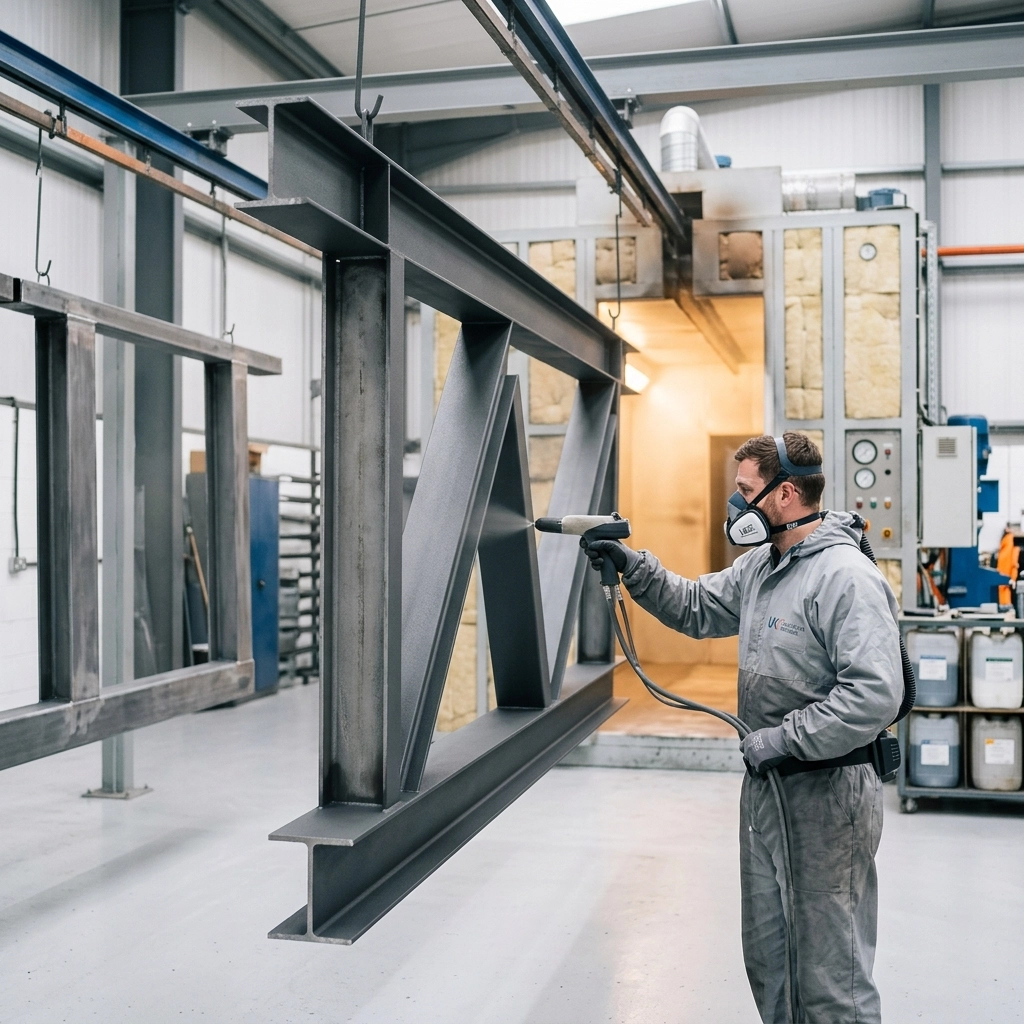
Most structural steel powder coating failures are caused by mistakes in preparation, application or curing — not by defects in the powder itself. According to AMPP (formerly NACE International), over 80% of premature coating failures trace back to inadequate surface preparation alone. The remaining 20% are split between incorrect powder selection, poor application technique and curing errors.
This guide covers the seven most common mistakes we see on structural steel projects, explains why each one leads to coating failure, and shows how to avoid them.
Key Takeaways
- 80% of coating failures are caused by preparation errors, not the powder
- Skipping shot blasting or using the wrong blast profile is the single biggest cause of peeling and adhesion failure
- Incorrect curing (under-cure or over-cure) makes the coating brittle, soft or poorly bonded
- Applying powder too thick is as damaging as applying it too thin
- Choosing the wrong powder chemistry for the environment leads to premature fading, chalking or corrosion
- Every mistake on this list is avoidable with the right process and equipment
- Source: BSI — BS EN ISO 12944 (corrosion protection of steel structures)
What Are the Most Common Structural Steel Powder Coating Mistakes?
The seven mistakes below cover the full coating process — from surface preparation through to dispatch. Each one is a real problem we see regularly on structural steel projects across London, Hertfordshire and Essex.
Mistake 1 — Why Does Skipping Proper Surface Preparation Cause Coating Failure?
Inadequate surface preparation is the number one cause of structural steel powder coating failure. If rust, mill scale, oil, grease or old coatings remain on the steel surface, the powder cannot form a proper bond. The coating may look fine initially but will begin to peel, blister or develop under-film corrosion within months.
What goes wrong:
- Mill scale is left on new steel because it “looks clean” — mill scale is loosely bonded iron oxide that will eventually flake, taking the coating with it
- Oil and grease from handling are not removed before blasting — they become embedded in the surface profile during shot blasting and prevent the coating from bonding
- The surface profile is too smooth — the powder has no mechanical key to grip onto
How to avoid it:
- Always degrease before blasting to remove oils and handling marks
- Shot blast to ISO 8501-1 Sa 2½ standard (near-white metal) as a minimum
- Achieve a surface profile of 50–75 microns for structural steel
- Coat within 4 hours of blasting to prevent flash rust
- At Spraytech, shot blasting and pre-treatment are included as standard on every structural steel job

Mistake 2 — What Happens If You Use the Wrong Pre-Treatment?
Mild steel and aluminium require completely different pre-treatment chemistry. Applying the wrong treatment — or skipping it altogether — compromises the chemical bond between the metal surface and the powder coating.
What goes wrong:
- Iron phosphate (for steel) is applied to aluminium — it does not react correctly with the aluminium surface
- Chromate-free conversion coating (for aluminium) is applied to steel — it provides inadequate corrosion protection
- Pre-treatment is skipped entirely to save time — the coating relies on mechanical bond alone, which is weaker
How to avoid it:
- Use iron phosphate conversion coating for mild steel
- Use chromate-free conversion coating for aluminium
- Never mix materials on the same pre-treatment line
- At Spraytech, we operate separate preparation lines for steel and aluminium to prevent cross-contamination
Mistake 3 — Why Does Applying Powder Too Thick or Too Thin Cause Problems?
Film thickness is one of the most overlooked variables in structural steel coating. Both over-application and under-application cause problems — and neither is visible to the naked eye without a coating thickness gauge.
What goes wrong:
- Too thin (under 50 microns) — the coating does not fully cover the surface profile peaks. Bare metal is exposed at the high points, creating entry points for moisture and corrosion
- Too thick (over 120 microns) — the coating becomes brittle and prone to cracking under the thermal expansion and contraction that structural steel undergoes with temperature changes. Thick coatings also cure unevenly, with the outer layer hardening while the inner layer remains soft
How to avoid it:
- Target 60–80 microns for most structural steel applications
- Use a digital coating thickness gauge to check readings at multiple points on every item
- Adjust gun settings (powder flow, air pressure, electrostatic charge) based on the component geometry
- At Spraytech, we measure film thickness on every item before dispatch
Mistake 4 — What Happens If Steel Is Under-Cured or Over-Cured?
Curing is where the powder transforms from a dry coating into a chemically cross-linked film. If the curing temperature is too low, the cure time too short, or the steel does not reach the required metal temperature, the coating will be under-cured. If the temperature is too high or the time too long, it will be over-cured. Both produce a defective finish.
What goes wrong:
- Under-cured — the powder melts and flows but does not fully cross-link. The coating looks normal but is softer, less chemically resistant and more prone to chipping and peeling. Under-cure is the most common curing error on structural steel because heavy sections take longer to reach the required metal temperature than thin sheet metal
- Over-cured — the coating becomes brittle, discoloured and may yellow (particularly on light colours). Over-cured coatings crack more easily under impact or thermal stress
How to avoid it:
- Cure based on metal temperature, not oven air temperature — heavy steel sections require longer soak times to reach 180–200°C throughout
- Use thermocouple data loggers to verify that the steel reaches the powder manufacturer’s specified cure window
- At Spraytech, our ovens accommodate sections up to 10 metres, and we monitor metal temperature on heavy structural items to ensure complete cure

Mistake 5 — Why Does Choosing the Wrong Powder Chemistry Lead to Failure?
Different environments attack coatings in different ways. A powder that performs well indoors will fail rapidly when exposed to UV light, rain, salt spray or industrial pollution outdoors. Choosing the wrong powder chemistry for the intended environment is a common specification error.
What goes wrong:
- Epoxy powder is used outdoors — epoxy has poor UV resistance and chalks and degrades within 12–18 months in direct sunlight
- Standard polyester is used in a coastal environment — it lacks the enhanced corrosion resistance needed within 5km of the coast
- Indoor-grade powder is used on external architectural metalwork — colour fading and gloss loss occur within 2–3 years
How to avoid it:
- Indoor (no UV exposure) — epoxy or hybrid (epoxy-polyester) is acceptable
- Outdoor (standard) — polyester is the correct choice; 15–25 year lifespan
- Outdoor (coastal or high-UV) — super durable polyester or fluoropolymer
- Outdoor (extreme corrosion) — duplex system (galvanising + powder coating)
- Match the powder to the ISO 12944 corrosivity category (C1–C5) of the installation site
Mistake 6 — What Is the Faraday Cage Effect and How Does It Cause Thin Spots?
The Faraday Cage effect is a phenomenon where electrostatically charged powder particles are repelled from recessed areas, internal corners, channels and the inside faces of hollow sections. The electrical field follows the path of least resistance and concentrates on outer edges and flat surfaces, leaving recesses under-coated.
What goes wrong:
- Internal corners of angle sections, channels and box sections are left with thin or no coating
- The back faces of I-beams and H-sections receive less powder than the flanges
- Bolt holes, gusset plates and stiffener plates trap air and deflect charged powder particles
How to avoid it:
- Manual application by experienced operators who adjust gun angle, distance and powder flow for each component geometry
- Reduce electrostatic charge (kV) when spraying into recesses — this reduces the repulsion effect
- Use tribo-charging guns for complex geometries where corona guns struggle
- At Spraytech, all structural steel is sprayed manually by experienced operators who understand how to manage Faraday Cage effects on complex fabrications
Mistake 7 — Why Does Poor Handling and Storage Damage Coated Steel?
The coating process does not end when the item leaves the oven. Coated structural steel is frequently damaged during handling, stacking, transport and storage — undoing the entire investment in preparation and coating.
What goes wrong:
- Coated items are stacked metal-to-metal without protection — contact points scratch through the coating to bare steel
- Items are stored outdoors or in damp conditions before dispatch — condensation forms under wrapping and causes flash corrosion at any coating imperfection
- Fork truck damage during loading — forks scratch or dent coated surfaces
- Coated items are welded, drilled or cut on site without masking — heat, sparks and mechanical damage destroy the coating locally
How to avoid it:
- Wrap and separate every coated item with foam, cardboard or VCI (vapour corrosion inhibitor) paper
- Store in a dry, covered environment until dispatch
- Use padded fork attachments or slings when handling coated steelwork
- Communicate with construction contractors and site teams about handling requirements before delivery
- At Spraytech, every item is wrapped and protected before leaving our facility
Frequently Asked Questions
What is the most common cause of structural steel coating failure?
Inadequate surface preparation. Over 80% of premature coating failures are caused by rust, mill scale, oil or contaminants left on the steel surface before coating. The powder bonds to the contaminant rather than the metal, leading to peeling, blistering and under-film corrosion.
How thick should powder coating be on structural steel?
The recommended film thickness for most structural steel powder coating is 60–80 microns. Below 50 microns, coverage is insufficient and bare metal may be exposed at profile peaks. Above 120 microns, the coating becomes brittle and prone to cracking under thermal stress.
What blast standard is required for structural steel before powder coating?
Most specifications require ISO 8501-1 Sa 2½ (near-white metal), meaning the surface has no more than 5% residual staining after blasting. The surface profile should be 50–75 microns for structural steel. Shot blasting to this standard is included on all Spraytech structural steel jobs.
Can under-cured powder coating be fixed?
In some cases, under-cured items can be returned to the oven for a second cure cycle. However, this only works if the under-cure is detected early and the powder has not been contaminated or damaged. Prevention — monitoring metal temperature during curing — is far better than correction.
What is the Faraday Cage effect in powder coating?
The Faraday Cage effect occurs when electrostatically charged powder particles are repelled from recessed areas, internal corners and hollow sections. The electrical field concentrates on exposed edges and flat surfaces, leaving recesses under-coated. Manual spraying with adjusted gun settings is the most effective way to overcome this on complex structural fabrications.
How do you prevent coating damage during transport?
Coated structural steel should be individually wrapped with foam, cardboard or VCI paper to prevent metal-to-metal contact. Items should be stored in dry conditions and handled with padded slings or fork attachments. At Spraytech, we wrap and protect every item before dispatch.
How long does structural steel powder coating last?
A correctly applied polyester powder coating on structural steel lasts 15–25 years in a normal outdoor environment. The actual lifespan depends on the quality of surface preparation, the coating system specified, the environmental exposure and whether the coating is maintained. In coastal or highly corrosive environments, super durable or duplex systems are recommended.
Conclusion
Every structural steel powder coating failure is traceable to one or more of these seven mistakes — and every one of them is preventable with the right process, equipment and expertise. The most critical step is surface preparation: get that right and the rest of the process has a solid foundation.
At Spraytech, we provide structural steel powder coating from two facilities in Bishop’s Stortford, with six ovens (up to 10m capacity), dedicated blast rooms and manual application by experienced operators. We serve steel fabricators, construction contractors and architects across London, Hertfordshire and Essex.