

How Does Aluminium Powder Coating Differ from Steel Coating?
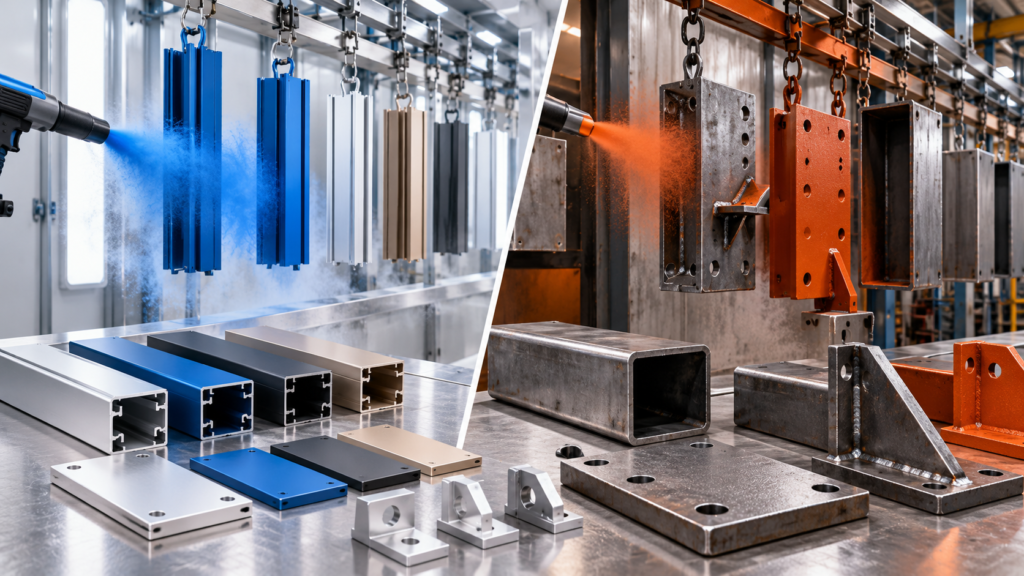
Aluminium powder coating uses the same electrostatic application and oven curing process as steel coating, but the preparation underneath is fundamentally different. Aluminium does not rust like steel — instead it forms a natural oxide layer that prevents coatings from bonding properly. This oxide must be removed and replaced with a controlled conversion coating before the powder is applied. Using the wrong preparation — or worse, the same preparation as steel — is one of the most common causes of coating failure on aluminium components.
This guide explains exactly what is different, why it matters, and how to get it right.
Key Takeaways
- The powder application and curing process is identical for aluminium and steel — the difference is entirely in the preparation
- Aluminium requires chromate-free conversion coating; steel requires iron phosphate — these are not interchangeable
- Aluminium must be blasted with non-ferrous media (aluminium oxide); steel grit embeds iron particles that cause under-film corrosion
- Aluminium is softer and thinner-walled than steel — blast pressure must be reduced to prevent warping
- Hexavalent chromate pre-treatments are now restricted under UK REACH regulations and are being replaced industry-wide with chromate-free alternatives
- At Spraytech, we operate separate preparation lines for aluminium and steel to prevent cross-contamination
What Is Aluminium Powder Coating?
Aluminium powder coating is the process of applying a dry polyester powder to aluminium components using an electrostatic spray gun and curing it in an oven at 180–200°C. The cured coating forms a hard, durable finish that protects the aluminium against weathering, UV degradation, scratching and surface corrosion.
Aluminium is the second most commonly powder coated metal in the UK after mild steel. It is widely used in architectural applications — curtain walling, window frames, cladding panels, balustrades and louvres — as well as in automotive, furniture and domestic metalwork such as alloy wheels and garden furniture.
The final powder coated finish on aluminium looks and performs identically to a finish on steel. The difference is in what happens before the powder is applied — and getting that wrong is where most aluminium coating failures begin.
How Does Aluminium Pre-Treatment Differ from Steel?
This is the critical difference. Aluminium and mild steel require completely different chemical pre-treatment processes. Using the wrong one — or skipping it — leads to adhesion failure, blistering and premature corrosion beneath the coating.
| Preparation Step | Mild Steel | Aluminium |
|---|---|---|
| Degreasing | Alkaline wash | Alkaline wash |
| Rust/oxide removal | Shot blasting (steel grit) | Shot blasting (aluminium oxide only) |
| Conversion coating | Iron phosphate | Chromate-free conversion coating |
| What it does | Creates corrosion-resistant iron phosphate layer | Removes natural oxide, creates adhesion-promoting conversion layer |
| Blast media | Steel grit or steel shot | Aluminium oxide or glass bead (never steel) |
| Blast pressure | Standard (80–100 psi) | Reduced (40–60 psi) to prevent warping |
| Flash rust risk | High — coat within 4 hours | Low — aluminium does not rust, but oxide reforms quickly |
| Cross-contamination risk | Low | High — ferrous particles from steel media cause corrosion |
At Spraytech, we operate separate preparation lines for aluminium and steel. This means aluminium items never come into contact with steel grit, iron phosphate chemicals or ferrous-contaminated equipment. Cross-contamination is one of the most common and most damaging mistakes in aluminium powder coating — and it is invisible until the coating begins to fail months later.
Why Can’t You Use Steel Grit to Blast Aluminium?
Steel grit and steel shot contain iron. When fired at aluminium, iron particles embed themselves in the soft aluminium surface. These particles are too small to see, but they are reactive — they corrode in the presence of moisture, creating tiny rust spots beneath the powder coating.
Over time, these rust spots expand and push the coating away from the aluminium surface, causing blistering, bubbling and adhesion failure. This is called ferrous contamination, and it is one of the most common causes of coating failure on aluminium — yet it is entirely preventable by using the correct media.
Correct media for aluminium:
- Aluminium oxide — angular, non-ferrous, produces a good surface profile for coating adhesion
- Glass bead — spherical, gentler, suitable for thin-walled or delicate aluminium items
At Spraytech, we use dedicated aluminium oxide media stored and used separately from our steel blasting equipment. Our shot blasting facilities are set up to prevent any cross-use of media between material types.
What Is Chromate-Free Conversion Coating?
Chromate-free conversion coating is a chemical pre-treatment applied to aluminium before powder coating. It removes the natural aluminium oxide layer and replaces it with a controlled conversion layer that promotes powder adhesion and provides a corrosion-resistant barrier beneath the coating.
Older aluminium pre-treatment processes used hexavalent chromate (Cr⁶⁺), which is highly effective but classified as a carcinogen. Hexavalent chromate is now restricted under UK REACH regulations and EU REACH, and the industry has largely transitioned to chromate-free alternatives based on zirconium, titanium or silane chemistry.
Chromate-free conversion coatings provide adhesion and corrosion performance comparable to the older chromate processes when applied correctly. At Spraytech, all aluminium pre-treatment uses chromate-free chemistry — this is both the current industry standard and a legal requirement for most applications.
Does Aluminium Need Shot Blasting Before Powder Coating?
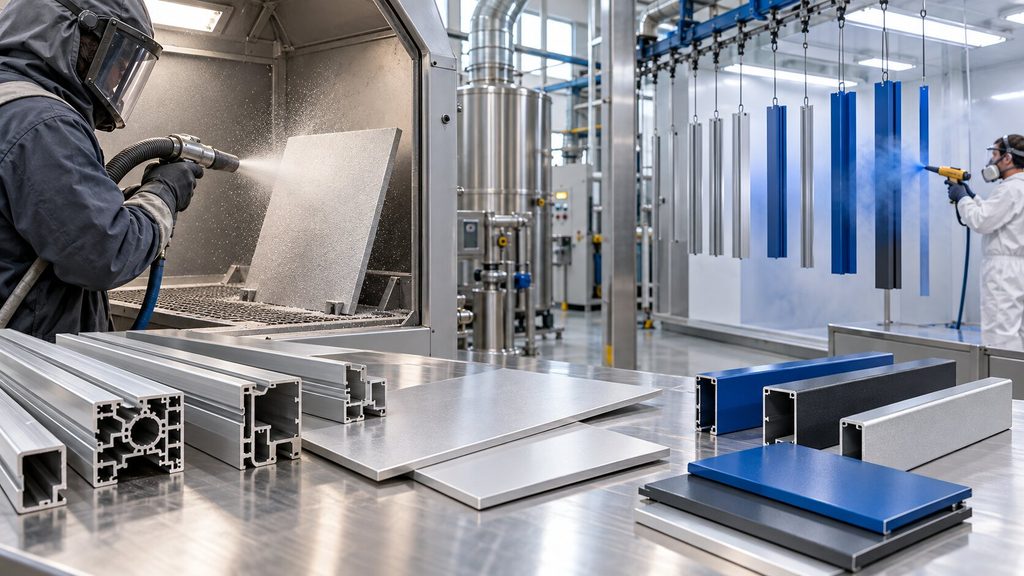
Not always. Unlike mild steel, which almost always requires shot blasting to remove rust and mill scale, aluminium often arrives in a clean enough condition to go straight to chemical pre-treatment.
Shot blasting IS needed when:
- The aluminium has an existing coating (paint, lacquer, old powder coat) that needs removing
- The surface has heavy oxidation, staining or pitting
- The specification requires a specific surface profile (e.g. 25–50 microns)
- The item is a refurbishment — old finish stripped back to bare metal
Shot blasting is NOT needed when:
- New aluminium extrusions or castings in clean condition
- Items that have been chemically cleaned and have no existing coating
- Thin-walled sections where blasting would risk warping
When blasting is required, we use aluminium oxide at reduced pressure (40–60 psi vs 80–100 psi for steel) to create a suitable profile without distorting the metal.
What Aluminium Components Can Be Powder Coated?
We provide aluminium powder coating for a wide range of applications:
- Curtain walling and window frames
- Cladding panels and rainscreen systems
- Balustrades, handrails and louvres
- Brise-soleil and solar shading
- Enclosures, housings and covers
- Heat sinks and electronic enclosures
- Machine parts and assemblies
- Alloy wheels
- Garden furniture (aluminium frames)
- Door and window frames
- Decorative items
We handle items from small brackets to architectural sections up to 10 metres in length.
How Long Does Aluminium Powder Coating Last?
A correctly applied polyester powder coating on aluminium typically lasts 15–25 years in a normal outdoor environment before visible degradation. In sheltered or indoor environments, it can last significantly longer.
Aluminium generally requires less maintenance than powder coated steel because the base metal does not corrode in the same way — there is no risk of rust forming beneath the coating through pinholes or scratches. Any exposed aluminium simply re-forms its natural oxide layer, which is far less damaging than the active rusting that occurs on exposed steel.
The lifespan depends on:
- Quality of pre-treatment — chromate-free conversion coating must be properly applied and fully cured before powder application
- Coating system — standard polyester for most applications; super durable polyester for coastal or high-UV environments
- Environmental exposure — coastal, industrial and high-UV locations reduce lifespan
- Maintenance — annual washing with a pH-neutral cleaner removes contaminants that accelerate degradation
Frequently Asked Questions
Can you powder coat aluminium?
Yes. Aluminium is one of the most commonly powder coated metals. It requires specific pre-treatment (chromate-free conversion coating instead of iron phosphate) and must be blasted with non-ferrous media if blasting is needed. At Spraytech, we operate separate aluminium preparation lines to ensure the correct process is followed.
Why does aluminium need different pre-treatment to steel?
Aluminium forms a natural oxide layer that prevents coatings from bonding. This oxide must be chemically removed and replaced with a controlled conversion coating. Steel corrodes differently — it rusts — and requires iron phosphate treatment. Using steel pre-treatment on aluminium results in poor adhesion and premature coating failure.
What happens if you use steel grit on aluminium?
Iron particles from the steel grit embed in the soft aluminium surface. These particles corrode beneath the coating, causing blistering and adhesion failure that may not appear for months. This is called ferrous contamination and is one of the most common causes of aluminium coating failure.
Is aluminium powder coating more expensive than steel?
Aluminium coating is typically 10–20% more expensive than steel coating because the pre-treatment process (chromate-free conversion) uses more expensive chemicals and requires more careful handling. Blasting with aluminium oxide media is also more expensive per kilogram than steel grit. However, the price difference per item is usually modest.
How do you prevent cross-contamination between aluminium and steel?
At Spraytech, we operate separate preparation lines, separate blast media and separate pre-treatment chemicals for aluminium and steel. Items are never processed on the wrong line. This is the most effective way to prevent ferrous contamination — the single biggest risk in aluminium powder coating.
What colours are available for aluminium powder coating?
The full RAL range — over 200 standard colours — in matt, satin, gloss, textured and metallic finishes. We also match BS colours and custom references. For architectural projects, we can provide sample panels for sign-off before production and maintain colour consistency across multi-phase deliveries.
Is chromate-free pre-treatment as good as chromate?
Modern chromate-free conversion coatings (based on zirconium, titanium or silane chemistry) provide adhesion and corrosion performance comparable to the older hexavalent chromate processes. Hexavalent chromate is now restricted under UK REACH regulations due to its carcinogenic properties, and the industry has largely transitioned to chromate-free as the standard.
Conclusion
Aluminium powder coating produces the same hard, durable, colourful finish as steel coating — but it requires fundamentally different preparation. The wrong blast media, the wrong conversion coating or cross-contamination between material lines can cause coating failures that are invisible at application but devastating months later.
At Spraytech, we operate dedicated aluminium preparation with chromate-free conversion coating, non-ferrous blast media and separate processing lines from two facilities in Bishop’s Stortford. We serve architects, fabricators, manufacturers and homeowners across London, Hertfordshire and Essex.