

Powder Coating vs Galvanising: Which Is Better for Steel?
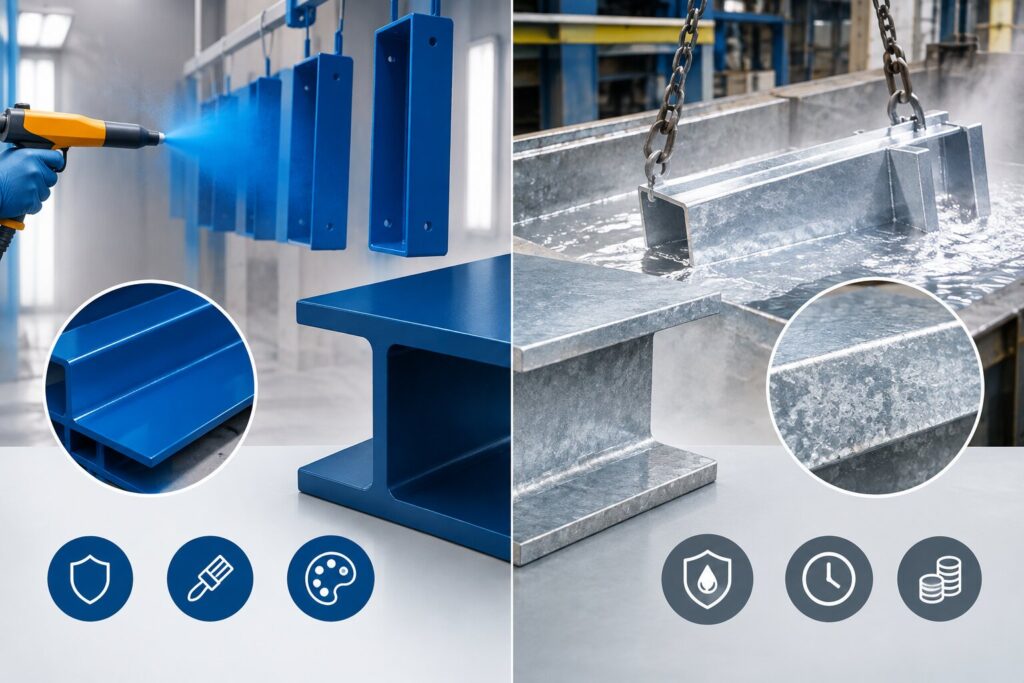
Powder coating vs galvanising are both used to protect steel from corrosion, but they work in completely different ways. Galvanising applies a layer of molten zinc to the steel surface, providing sacrificial corrosion protection. Powder coating applies a dry polymer finish that forms a hard, coloured barrier. Both have their place — galvanising provides superior corrosion protection in harsh environments, while powder coating offers a wider colour range, better appearance and a smoother finish. In many cases, the best result comes from using both together in a duplex system. This guide compares the two on every measure that matters.
Key Takeaways
- Galvanising protects steel by sacrificial corrosion — the zinc corrodes instead of the steel underneath
- Powder coating protects steel by barrier protection — the cured coating seals moisture and air away from the metal
- Galvanising lasts 50–100 years in rural environments but only 10–25 years in coastal or industrial conditions
- Powder coating lasts 15–25 years outdoors and can be applied in 200+ RAL colours
- Duplex coating (galvanising + powder coating together) lasts 1.5–2.3x longer than either method alone
- The choice depends on environment, appearance requirements and budget
What Is the Difference Between Powder Coating and Galvanising?
The fundamental difference is how each method protects the steel. Galvanising uses sacrificial protection — a zinc layer that corrodes preferentially, protecting the steel even if the coating is scratched or damaged. Powder coating uses barrier protection — a sealed polymer film that physically prevents moisture, oxygen and chemicals from reaching the steel surface.
| Feature | Powder Coating | Hot Dip Galvanising |
|---|---|---|
| Protection type | Barrier (sealed film) | Sacrificial (zinc corrodes first) |
| Application | Electrostatic spray + oven cure at 180–200°C | Steel dipped in molten zinc at 450°C |
| Coating thickness | 60–120 microns | 45–85 microns (varies by steel thickness) |
| Corrosion protection | Good (sealed barrier) | Excellent (sacrificial + barrier) |
| Self-healing | No — damage exposes bare steel | Yes — surrounding zinc protects exposed areas |
| Colour range | 200+ RAL colours, matt/satin/gloss/textured | Silver-grey only (no colour choice) |
| Surface finish | Smooth, consistent, decorative | Rough, spangled, industrial appearance |
| UV resistance | Excellent (polyester) | Poor — zinc surface dulls and weathers |
| Lifespan (urban) | 15–25 years | 40–70 years |
| Lifespan (coastal) | 10–20 years | 10–25 years |
| Scratch resistance | Good — hard cured film | Moderate — zinc is softer than steel |
| Touch-up repair | Difficult — must strip and recoat | Easy — zinc spray or paint touch-up |
| Weight added | Negligible | 3–6% increase |
| Cost (domestic items) | £80–£150 per pair of gates | £60–£120 per pair of gates |
| Cost (structural steel) | £2–£8/m² | £1.50–£5/m² |
| Best for | Appearance, colour, decorative use | Maximum corrosion life, structural steel |
How Does Hot Dip Galvanising Work?
Hot dip galvanising involves dipping fabricated steel into a bath of molten zinc at approximately 450°C. The zinc reacts with the steel surface to form a series of zinc-iron alloy layers, topped by a layer of pure zinc. This metallurgical bond means the coating cannot peel or flake like paint — it is physically part of the steel surface.
The zinc coating protects the steel in two ways. First, it forms a physical barrier that prevents moisture and oxygen from reaching the steel. Second, if the coating is scratched or damaged, the surrounding zinc corrodes preferentially — sacrificing itself to protect the exposed steel. This is called cathodic protection, and it is why galvanised steel can tolerate minor surface damage without rusting.
Galvanising is governed by BS EN ISO 1461 in the UK, which specifies minimum coating thickness based on the steel section thickness.
How Does Powder Coating Protect Steel?
Powder coating protects steel by forming a continuous, sealed polymer film on the surface. The dry powder is applied electrostatically and cured in an oven at 180–200°C, causing the powder particles to melt and chemically cross-link into a hard, dense coating.
This coating works as a barrier — it physically prevents moisture, oxygen, salt, chemicals and UV light from reaching the steel underneath. As long as the coating remains intact, the steel beneath it will not corrode.
The key difference from galvanising is that powder coating has no self-healing ability. If the coating is chipped, scratched or damaged, bare steel is exposed directly to the environment and corrosion begins at that point. This is why proper surface preparation — including shot blasting and pre-treatment — is critical before powder coating. The coating must bond completely to prevent any pathway for moisture to reach the metal.
At Spraytech, we include shot blasting and iron phosphate pre-treatment as standard on all mild steel powder coating work.
When Should You Choose Powder Coating Over Galvanising?
Powder coating is the better choice when:
Appearance matters — Galvanising produces a grey, spangled surface that cannot be coloured. Powder coating is available in 200+ RAL colours with matt, satin, gloss and textured finishes. For architectural metalwork, domestic gates and railings, shopfronts and any visible metalwork, powder coating is the standard choice.
Colour matching is required — If the metalwork must match a specific RAL reference, brand colour or existing building elements, powder coating is the only option. Galvanising cannot be colour-matched.
A smooth finish is needed — Powder coating produces a smooth, even surface. Galvanised finishes are rougher and can have drips, runs or lumps at drainage points, which may not be acceptable on decorative or customer-facing metalwork.
The environment is moderate — In urban and suburban environments with normal weather exposure, a quality powder coat provides 15–25 years of protection — more than sufficient for most applications.
When Should You Choose Galvanising Over Powder Coating?
Galvanising is the better choice when:
Maximum corrosion life is the priority — In harsh environments (coastal, industrial, buried or submerged), galvanising significantly outlasts powder coating. A galvanised finish in a rural environment can last 70–100 years.
The steel will be damaged in service — Galvanising’s sacrificial protection means scratches and minor impacts do not lead to immediate corrosion. For items that will be handled roughly, dragged, stacked or exposed to mechanical damage, galvanising is more forgiving.
Appearance is not important — Structural steelwork hidden behind cladding, underground supports, agricultural equipment and industrial frameworks do not need a decorative finish. Galvanising provides superior protection at a lower cost.
The item is complex or hollow — Galvanising coats inside and outside simultaneously because the item is fully submerged. Powder coating only coats accessible external surfaces. For hollow sections, tubes and items with internal cavities, galvanising provides internal protection that powder coating cannot.
Can You Powder Coat Over Galvanised Steel?
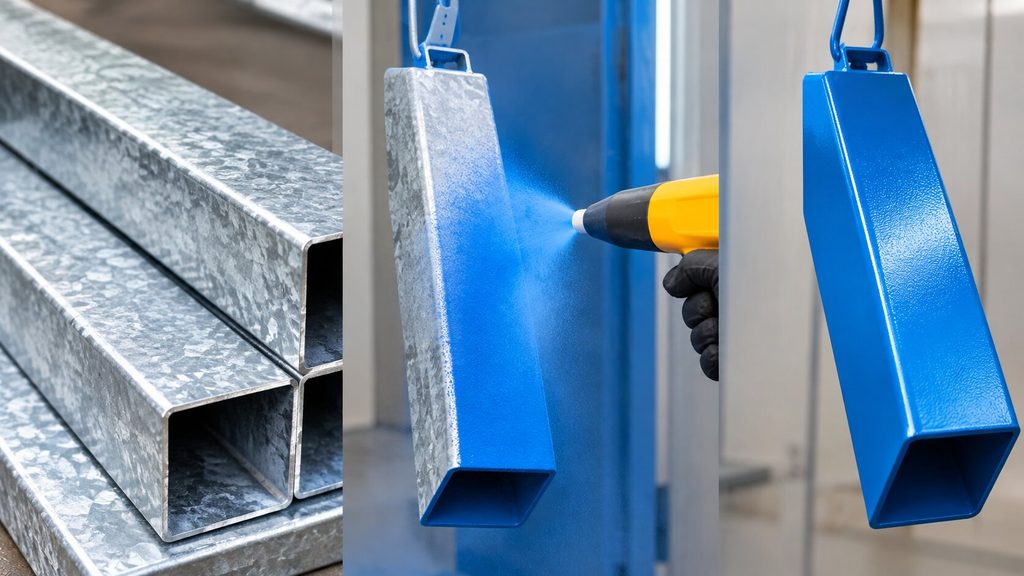
Yes. Applying powder coating over galvanised steel is called a duplex system, and it provides the best of both methods — the sacrificial corrosion protection of zinc combined with the colour, appearance and UV resistance of powder coating.
A duplex coating lasts significantly longer than either galvanising or powder coating alone. According to the Galvanizers Association, a duplex system provides 1.5 to 2.3 times the combined protection life of the two coatings applied separately. This synergy occurs because the powder coating shields the zinc from atmospheric weathering, slowing the rate at which the zinc layer is consumed.
However, powder coating galvanised steel requires specific preparation. Zinc outgasses at powder coating curing temperatures (180–200°C), which can cause pinholes and bubbling in the coating if not managed correctly. At Spraytech, we pre-bake galvanised items before coating to drive off trapped moisture and gases, then apply a specific etch primer before the powder coat. This prevents outgassing defects and ensures a clean, durable finish.
Duplex systems are commonly specified on architectural balustrades, highway barriers, bridge components and external structural steelwork where both maximum corrosion life and a coloured finish are required.
How Do Costs Compare?
| Item | Powder Coating | Galvanising | Duplex (Both) |
|---|---|---|---|
| Pair of garden gates | £80–£150 | £60–£120 | £140–£250 |
| Railing (per metre) | £15–£30 | £10–£20 | £25–£45 |
| Structural steel (per m²) | £2–£8 | £1.50–£5 | £4–£12 |
| Balustrade section | £20–£40 | £15–£30 | £35–£65 |
Galvanising is generally cheaper per item than powder coating for plain, uncoloured protection. Powder coating costs more because of the additional application and curing process. Duplex systems cost the most upfront but provide the longest protection life and lowest cost per year of service.
For most domestic applications — gates, railings, furniture — powder coating alone provides excellent value. For industrial and structural steelwork in harsh environments, duplex is the most cost-effective long-term choice.
Frequently Asked Questions
Is powder coating better than galvanising?
It depends on the application. Powder coating is better for appearance, colour choice and decorative metalwork. Galvanising is better for maximum corrosion protection in harsh environments and for steel that will be mechanically damaged in service. For the best overall protection with a coloured finish, a duplex system (galvanising + powder coating) outperforms either method alone.
How long does galvanising last compared to powder coating?
In a typical urban environment, galvanising lasts 40–70 years and powder coating lasts 15–25 years. In coastal environments, both are reduced — galvanising to 10–25 years and powder coating to 10–20 years. A duplex system (both together) lasts 1.5–2.3 times longer than either alone.
Can you powder coat galvanised steel?
Yes, but it requires specific preparation. Galvanised steel must be pre-baked to remove trapped moisture and gases, then treated with an etch primer before powder coating. Without this preparation, the zinc outgasses during curing and causes pinholes and bubbling in the finish. At Spraytech, we follow a dedicated galvanised steel preparation process.
What is a duplex coating system?
A duplex system combines hot dip galvanising with powder coating applied on top. The galvanising provides sacrificial corrosion protection and the powder coating provides colour, UV resistance and a sealed barrier that slows zinc weathering. The result lasts significantly longer than either method used individually.
Is galvanising cheaper than powder coating?
For plain, uncoloured protection, galvanising is typically 20–30% cheaper than powder coating per item. However, powder coating provides colour and a smoother finish, which galvanising cannot. Over a 20-year period, powder coating is usually more cost-effective than repainting, and a duplex system offers the lowest cost per year of protection.
Does galvanised steel rust?
Eventually, yes. The zinc coating corrodes slowly over decades, and once it is fully consumed, the steel beneath will begin to rust. The rate of zinc consumption depends on the environment — faster in coastal, industrial and acidic conditions, slower in rural and dry environments. This is why galvanised coatings have different expected lifespans depending on location.
Which should I choose for garden gates?
For garden gates, powder coating is usually the best choice because appearance and colour matter. A polyester powder coat in your chosen RAL colour will last 15–25 years and look good throughout. If the gates are in a coastal location or need maximum lifespan, consider a duplex system — galvanise first, then powder coat on top for both protection and colour.
Conclusion
Powder coating and galvanising protect steel in different ways, and the right choice depends on your priorities. Powder coating wins on appearance, colour and finish quality. Galvanising wins on raw corrosion protection and self-healing ability. A duplex system combining both provides the longest-lasting protection with a coloured finish.
At Spraytech, we provide powder coating for mild steel, galvanised steel and aluminium from two facilities in Bishop’s Stortford, serving London, Hertfordshire, Essex and the South East. We can coat galvanised items with full pre-bake and etch primer preparation.