

Powder Coating vs Painting: Best for Industrial Projects?
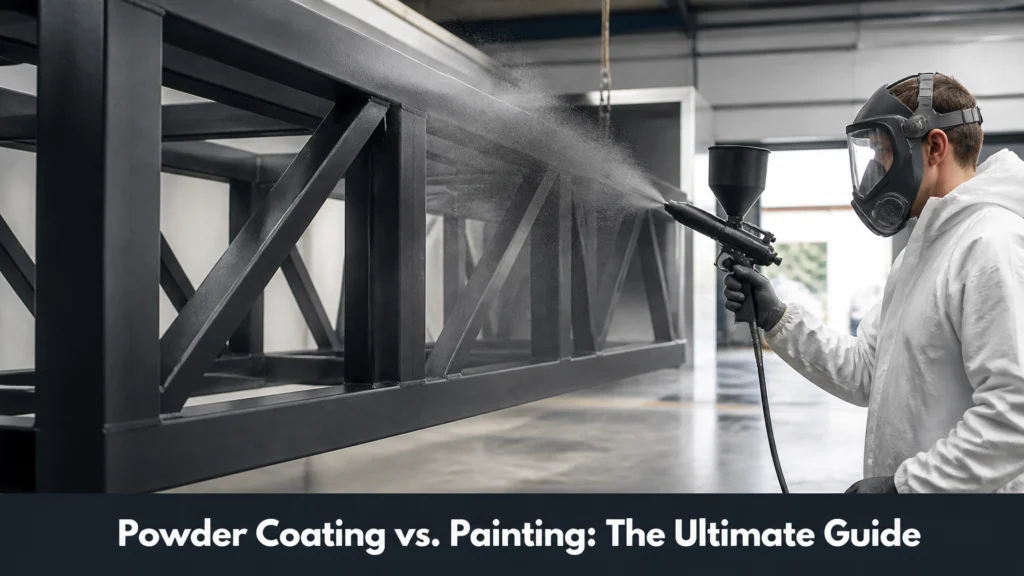
Powder coating vs painting are the two most common methods for finishing metal, but they work differently and produce very different results. Powder coating is a dry process — electrostatically applied and oven-cured at 180–200°C — that produces a harder, thicker and more durable finish than wet paint. It lasts 15–25 years outdoors compared to 2–5 years for paint, releases near-zero VOCs, and wastes less than 5% of material.
Paint is cheaper upfront and can be applied on site, but requires more frequent maintenance. This guide compares the two on every measure that matters.
Key Takeaways
- Powder coating lasts 15–25 years outdoors; paint lasts 2–5 years
- Powder coat film thickness is 60–120 microns vs 25–50 microns for paint — 2–3x thicker in a single coat
- Powder coating releases near-zero VOCs; solvent-based paint releases 300–500 g/l (source: HSE — Introduction to Powder Coating)
- Powder coating costs more upfront but less over the lifetime due to fewer recoats
- Paint is the better choice for on-site repairs, oversized items and heat-sensitive materials
What Is the Difference Between Powder Coating vs Painting?
The core difference is how the finish is applied and how it bonds to the metal. Painting applies a liquid coating that dries by evaporation — the solvent or water carrier leaves the film behind. Powder coating applies a dry powder electrostatically and cures it in an oven, where the powder melts and chemically cross-links into a continuous, hard film. This cross-linking reaction is what gives powder coating its superior hardness, adhesion and durability.
| Feature | Powder Coating | Wet Paint |
|---|---|---|
| Application | Dry powder, electrostatic spray | Liquid, brush/spray/roller |
| Curing | Oven at 180–200°C | Air drying or low-temp bake |
| Film thickness | 60–120 microns (single coat) | 25–50 microns per coat |
| Bonding | Chemical cross-link (permanent) | Evaporation (surface adhesion) |
| Durability (outdoor) | 15–25 years | 2–5 years |
| Chip resistance | Excellent | Moderate |
| Scratch resistance | Excellent | Moderate |
| Corrosion protection | Excellent (sealed barrier) | Moderate (permeable over time) |
| UV resistance | High (polyester) | Moderate (fades faster) |
| VOC emissions | Near zero | 300–500 g/l (solvent-based) |
| Material waste | Under 5% (overspray recycled) | 30–50% (overspray lost) |
| Colour range | 200+ RAL colours | Unlimited custom mixing |
| On-site application | No (requires oven) | Yes |
| Cost per unit | Higher upfront | Lower upfront |
| Lifecycle cost | Lower (fewer recoats) | Higher (repeated maintenance) |
Is Powder Coating More Durable Than Paint?
Yes. Powder coating is significantly more durable than paint on every key measure. A correctly applied polyester powder coating lasts 15–25 years on outdoor metalwork before visible degradation, compared to 2–5 years for standard exterior paint. This means powder coated gates, railings and fencing will still look good after a decade, while painted equivalents will have chipped, faded and started to rust.
The durability advantage comes from three factors:
Thickness — Powder coating applies at 60–120 microns in a single coat. Paint typically applies at 25–50 microns per coat. A thicker coating provides a larger physical barrier between the metal and the environment.
Bonding — Powder coating chemically cross-links during curing, forming a continuous film that is bonded to the metal at a molecular level. Paint dries by evaporation and sits on the surface — it does not form the same chemical bond.
Preparation — Professional powder coating always includes shot blasting and chemical pre-treatment before coating. This creates a clean, profiled surface that the powder bonds to permanently. Painting can be applied over less thorough preparation, which is convenient but leads to earlier failure.

Is Powder Coating Cheaper Than Painting?
Powder coating costs more per unit upfront, but it is almost always cheaper over the full lifecycle of the item. The reason is simple: you coat once and it lasts 15–25 years, whereas painting typically needs to be redone every 3–5 years.
Upfront Cost Comparison (Domestic Items)
| Item | Powder Coating | Painting |
|---|---|---|
| Pair of garden gates | £80–£150 | £40–£80 |
| Set of 4 garden chairs | £60–£120 | £30–£60 |
| Metal railing (per metre) | £15–£30 | £8–£15 |
| Alloy wheel | £40–£70 | £25–£45 |
20-Year Lifecycle Cost Example
| Powder Coating | Painting | |
|---|---|---|
| Initial coat | £120 | £60 |
| Recoats needed in 20 years | 0 | 4 (every 5 years) |
| Total recoat cost | £0 | £240 |
| Total 20-year cost | £120 | £300 |
Over 20 years, the painted item costs 2.5x more than the powder coated one — and that is before accounting for the time, disruption and preparation involved in each repaint.
For industrial and architectural projects, the lifecycle savings are even larger because of the scale of metalwork involved and the cost of on-site access for repainting (scaffolding, closures, etc.).
Is Powder Coating Better for the Environment Than Paint?
Yes. Powder coating is better for the environment than painting on every key measure. It releases near-zero VOCs compared to 300–500 g/l for solvent-based paint, wastes under 5% of material (overspray is recycled) compared to 30–50% for paint, and generates no hazardous solvent waste.
The UK’s VOC Regulations 2012 set maximum VOC limits for paints and coatings. Powder coating falls well within these limits because it contains effectively zero VOCs — there are no solvents in the powder at all. The Health and Safety Executive (HSE) provides guidance on the safe use of coating powders, recognising powder coating as a lower-risk finishing method compared to solvent-based spray painting.
For construction contractors and architects working towards BREEAM or LEED certification, specifying powder coating over wet paint contributes to materials and indoor air quality credits.

When Is Painting Better Than Powder Coating?
Painting is the better choice in specific situations where powder coating is not practical:
On-site repairs and touch-ups — Powder coating requires an oven, so it cannot be done on site. If a coated railing is scratched during installation, the touch-up must be done with paint. For small repairs on already-installed metalwork, paint is the only option.
Oversized items — Powder coating is limited by oven size. At Spraytech, our largest oven is 10 metres. Items longer than this — such as large bridge sections or very long structural beams — must be wet-painted on site or in a dedicated painting facility.
Heat-sensitive materials — The curing oven operates at 180–200°C. Materials that cannot withstand this heat (certain plastics, wood, items with sealed electronics) cannot be powder coated. For wood-based components, Spraytech offers a separate MDF spray finishing service using low-temperature coatings.
Colour matching on site — Wet paint can be mixed to any colour on the spot. Powder coating uses pre-manufactured powder, which must be ordered in the correct RAL reference. For urgent colour matching on site, paint is faster.
Which Should You Choose for Your Project?
| Your Situation | Best Choice |
|---|---|
| External metalwork (gates, railings, fencing) | Powder coating |
| Architectural metalwork (balustrades, cladding, curtain walling) | Powder coating |
| Industrial components and structural steelwork | Powder coating |
| Alloy wheels and automotive parts | Powder coating |
| On-site touch-ups and repairs | Paint |
| Items over 10 metres long | Paint |
| Heat-sensitive or non-metallic items | Paint |
| Budget-only, short-term finish | Paint |
If durability, corrosion protection and long-term cost matter — which they do on almost every construction, manufacturing and architectural project — powder coating is the better choice.

Frequently Asked Questions
Is powder coating better than painting?
For metal items, yes. Powder coating is harder, thicker (60–120 microns vs 25–50 microns), more chip-resistant and lasts 15–25 years outdoors compared to 2–5 years for paint. It also releases near-zero VOCs and wastes less material. The only areas where paint is better are on-site repairs, oversized items and heat-sensitive materials.
How much does powder coating cost compared to painting?
Powder coating costs roughly 50–70% more upfront per item. However, over a 20-year period, powder coating is typically 2–3 times cheaper because it does not need recoating every 3–5 years. A pair of gates costs £80–£150 to powder coat vs £40–£80 to paint, but the paint will need 4 recoats in the same period.
Can you paint over powder coating?
Yes, for small touch-ups and repairs, paint can be applied over a powder coated surface after light sanding. However, this does not provide the same durability as the original powder coat. For a full refinish, the old coating should be removed by shot blasting and a new powder coat applied.
Can you powder coat over existing paint?
It is not recommended. For the best adhesion and finish quality, existing paint should be removed before powder coating. Coating over old paint can cause bubbling, peeling and adhesion failure. Shot blasting is the most effective way to remove old paint before recoating.
Does powder coating chip?
Powder coating is highly chip-resistant — far more so than paint — but it is not chip-proof. Heavy impact from stones, tools or kerbing can still damage the coating. However, a chip in a powder coat exposes a much smaller area than a chip in paint, and the surrounding coating remains firmly bonded to the metal.
Is powder coating waterproof?
Powder coating creates a sealed, moisture-resistant barrier that protects metal from rain, humidity and condensation. It is not rated as waterproof for submersion, but for all normal outdoor exposure it provides excellent water protection — which is why it is the standard finish for external gates, railings and metalwork.
How long does powder coating take compared to painting?
Most powder coating jobs are completed within 48–72 hours. Painting can be faster for single coats but slower overall when multiple coats and drying time between them are factored in. At Spraytech, our 48-hour average turnaround covers most domestic and commercial work.
Does powder coating last longer than paint?
Yes, in most cases. Powder coating is applied thicker and cured into a hard film, so it typically lasts 15–25 years outdoors on steel, while conventional paint often needs redoing within a few years. See how long powder coating lasts.
Is powder coating better than spray painting?
For metal that needs to last, yes. Spray paint is quick and cheap for small touch-ups, but the film is thinner and softer and chips more easily. Powder coating gives a thicker, more even and more durable finish, but it needs an oven, so it is done in a workshop rather than at home or on site.
Conclusion
Powder coating outperforms painting on durability, chip resistance, corrosion protection, environmental impact and lifecycle cost. Paint wins only for on-site repairs, oversized items and situations where the lowest upfront cost is the only priority.
For most metal finishing applications — domestic, industrial and architectural — powder coating is the better choice. Spraytech provides powder coating from two facilities in Bishop’s Stortford, serving London, Hertfordshire, Essex and the South East. For a free quote, see our powder coating near Harlow and Bishop’s Stortford.