

What Is Powder Coating and How Does It Work?
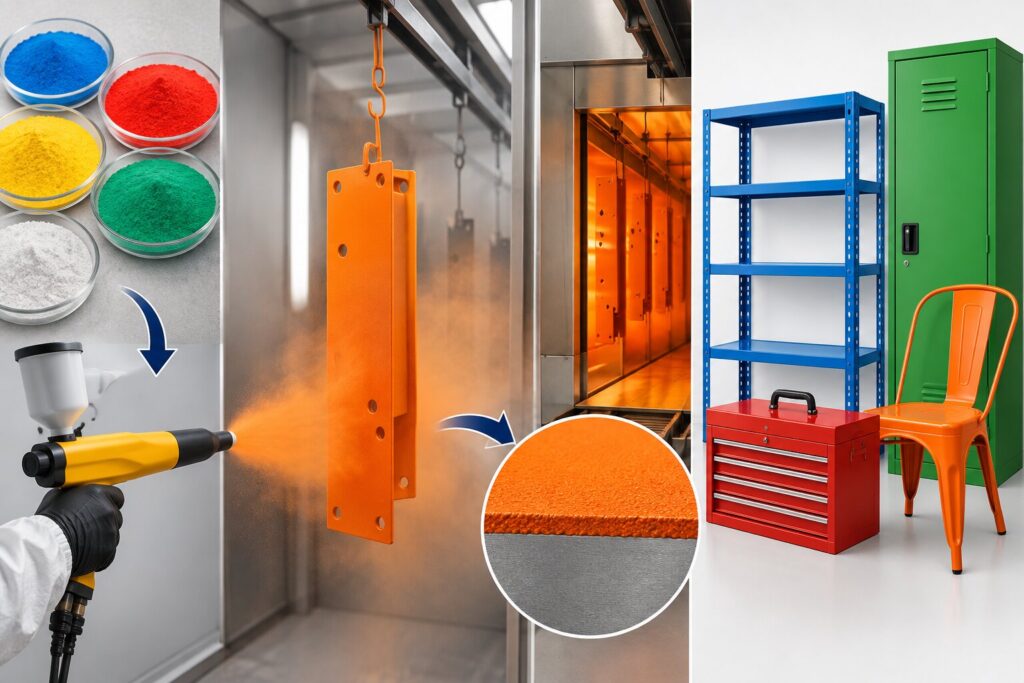
Powder coating is a dry finishing process that applies a fine polymer powder to metal surfaces using an electrostatic charge, then cures it in an oven to form a hard, protective coating. It is one of the most widely used metal finishing methods in the UK, used on everything from garden gates and railings to structural steelwork on major construction projects. This guide explains exactly how powder coating works, what it costs, how long it lasts and when it is the right choice.
Key Takeaways
- Powder coating is a dry finishing process — no liquid solvents or wet paint involved
- The coating is cured in an oven at 180–200°C, bonding permanently to the metal
- A quality powder coat lasts 15–25 years outdoors, compared to 2–3 years for standard paint
- Powder coating releases near-zero VOCs, making it one of the most environmentally friendly finishing methods.
- It can be applied to steel, aluminium, galvanised metal and cast iron in hundreds of RAL colours
What Is Powder Coating?
Powder coating is a metal finishing process where a dry powder — typically made from polyester, epoxy or a hybrid resin — is applied to a metal surface using an electrostatic spray gun. The charged powder particles adhere to the grounded metal workpiece, and the coated item is then placed in a curing oven at 180–200°C. The heat melts the powder and causes it to chemically cross-link, forming a continuous, hard coating that is far more durable than conventional wet paint.
The powder coating process was first developed in the 1950s in Germany and became commercially widespread in the 1970s. Today, powder coating accounts for over 15% of all industrial finishing applications globally (source: Grand View Research, 2023). In the UK, it is the standard finishing method for architectural metalwork, industrial components and domestic metalwork including gates, railings and garden furniture.
Unlike liquid paint, powder coating contains no solvents and releases near-zero volatile organic compounds (VOCs) during application. Overspray powder can be collected and reused, meaning material waste is typically below 5% — compared to 30–50% waste with conventional spray painting.
How Does Powder Coating Work? (Step-by-Step Process)
The powder coating process follows five stages. Each stage directly affects the quality, adhesion and lifespan of the finished coating.
Step 1 — Surface Preparation
The metal surface is cleaned to remove oil, grease, dirt, rust, mill scale and old coatings. This is the most critical step in the entire process — the coating can only bond properly to a clean, contaminant-free surface. Methods include chemical degreasing, shot blasting (using steel shot or grit to strip the surface back to bare metal) and phosphate pre-treatment to create a corrosion-resistant base layer.
For aluminium, a chromate-free conversion coating is applied instead, which promotes adhesion and prevents oxidation beneath the powder coat.
Step 2 — Powder Application
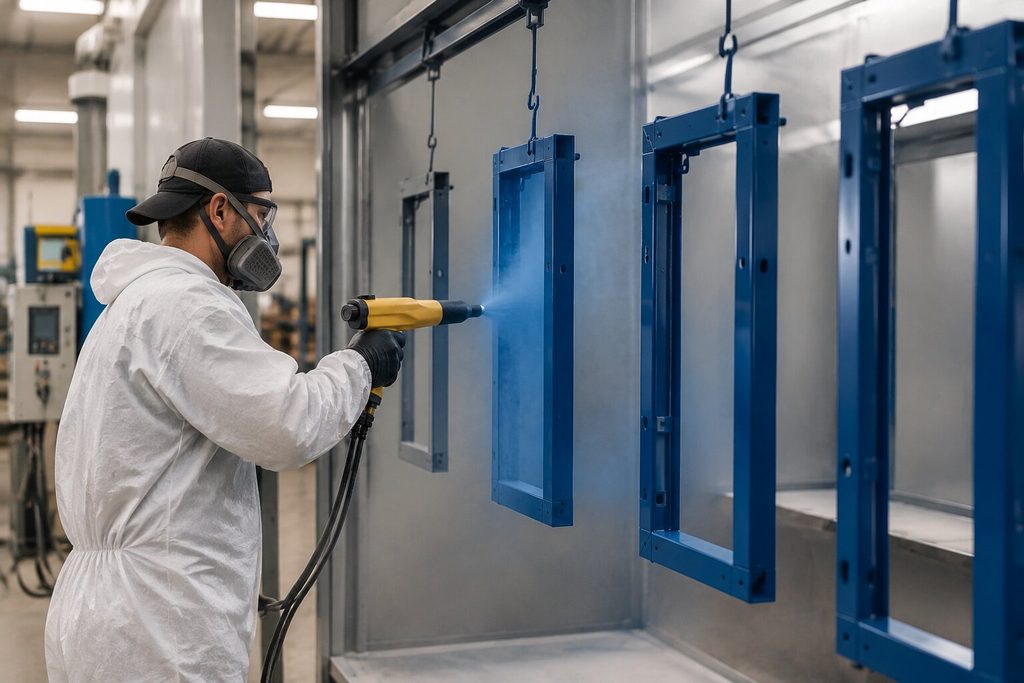
The dry powder is loaded into an electrostatic spray gun. As the powder exits the gun, it passes through a charged field that gives each particle a positive electrostatic charge. The metal workpiece is grounded (earthed), so the charged powder particles are attracted to the surface and cling to it evenly — including around edges, corners and recessed areas.
The electrostatic attraction holds the powder in place until curing. This means items can be moved and handled after spraying without disturbing the coating.
Step 3 — Curing
The coated item is placed in a curing oven at a temperature between 180°C and 200°C for 10 to 20 minutes (depending on the powder type and metal thickness). The heat melts the powder particles, which flow together and chemically cross-link to form a continuous film. This cross-linking reaction is what gives powder coating its hardness, chemical resistance and durability — it is a fundamentally different bonding mechanism from paint drying.
Step 4 — Cooling
After curing, the item is removed from the oven and allowed to cool. The coating reaches its full hardness within minutes. Once cooled, the item is ready for inspection, assembly or dispatch.
Step 5 — Inspection and Quality Checks
The finished coating is inspected for film thickness (measured with a digital coating thickness gauge), adhesion, surface finish quality, colour accuracy and freedom from defects such as orange peel, pinholes or runs. At Spraytech, every item is checked before it leaves our facility.
What Types of Powder Coating Are There?
There are three main types of powder coating, each suited to different applications and environments:
| Type | Best For | Key Properties | Typical Lifespan (Outdoor) |
|---|---|---|---|
| Polyester | External architectural, gates, railings, furniture | Excellent UV resistance, colour retention, weather resistance | 15–25 years |
| Epoxy | Internal industrial, electronics, pipework | High chemical and corrosion resistance, poor UV resistance | 10–15 years (indoor only) |
| Hybrid (Epoxy-Polyester) | Internal decorative, office furniture, appliances | Good surface finish, moderate chemical resistance | 10–15 years (indoor only) |
Polyester powder coating is the most common choice for external applications in the UK, including architectural and domestic metalwork. Epoxy coatings are typically used for internal industrial components where chemical resistance matters more than UV stability.
What Metals Can Be Powder Coated?
Powder coating can be applied to any metal that conducts electricity and withstands oven curing temperatures of 180–200°C. The most commonly powder coated metals are:
- Mild steel — the most widely coated material; used in gates, railings, structural steelwork, fabricated components and industrial equipment
- Aluminium — widely used in architectural applications including curtain walling, window frames, cladding panels and balustrades
- Galvanised steel — requires specific pre-treatment to avoid outgassing during curing, but produces excellent corrosion resistance when coated correctly
- Cast iron — radiators, fire surrounds, decorative items and heritage components
- Stainless steel — less common but used where additional colour or corrosion protection is required
Materials that cannot be powder coated include wood, plastic, rubber and non-conductive materials (although MDF spray finishing is a separate process we offer for wood-based components).
How Long Does Powder Coating Last?
A correctly applied polyester powder coating typically lasts 15 to 25 years on external metalwork before visible degradation occurs. This compares to 2 to 3 years for standard exterior paint, which is why powder coating is the preferred finish for gates, railings, fencing and architectural metalwork.
The actual lifespan depends on four factors:
- Quality of surface preparation — poor preparation is the number one cause of premature coating failure. If rust, oil or old paint remains under the coating, adhesion is compromised from day one.
- Coating system — polyester lasts longer than epoxy outdoors. Super durable polyester and marine-grade systems extend the lifespan further.
- Environmental exposure — coastal environments, industrial pollution and constant direct UV exposure all accelerate degradation.
- Maintenance — annual washing with soapy water removes surface contaminants that can degrade the coating over time.
According to Qualicoat (the European quality label for architectural powder coating), a Class 1 polyester coating should maintain acceptable gloss retention and colour stability for a minimum of 10 years in a normal environment, with most installations lasting significantly longer.
Powder Coating vs Paint — What Is the Difference?
| Feature | Powder Coating | Wet Paint |
|---|---|---|
| Application method | Dry powder, electrostatic spray | Liquid, brush/spray/roller |
| Curing | Oven at 180–200°C | Air drying or low-temperature bake |
| Thickness | 60–120 microns (single coat) | 25–50 microns per coat |
| Durability (outdoor) | 15–25 years | 2–5 years |
| Chip/scratch resistance | Excellent | Moderate |
| VOC emissions | Near zero | High (solvent-based) or moderate (water-based) |
| Material waste | Under 5% (overspray reused) | 30–50% overspray lost |
| Colour range | 200+ RAL colours | Unlimited custom mixing |
| Cost per unit | Higher upfront, lower lifecycle cost | Lower upfront, higher maintenance |
For most metal finishing applications — particularly external metalwork, architectural components and industrial parts — powder coating provides a significantly more durable, cost-effective and environmentally responsible finish than paint.
How Much Does Powder Coating Cost in the UK?
Powder coating costs vary depending on the size and complexity of the item, the amount of surface preparation required and the coating system specified. As a general guide for domestic items:
- Pair of garden gates: £80–£150
- Set of 4 garden chairs: £60–£120
- Single alloy wheel: £40–£70
- Metal railing section (per metre): £15–£30
- Bike frame: £50–£90
For industrial and architectural projects, pricing is based on batch size, specification requirements and turnaround time. Contact Spraytech with your drawings, photos or items for a specific quote.
Frequently Asked Questions
Is powder coating better than painting?
For metal items, powder coating is significantly more durable than paint. A powder coated finish typically lasts 15–25 years outdoors, compared to 2–3 years for standard paint. Powder coating is also more resistant to chipping, scratching, fading and corrosion. It produces near-zero VOC emissions and generates less waste, making it more environmentally friendly.
Can you powder coat over existing paint?
It is not recommended. For the best adhesion and finish quality, existing paint should be removed before powder coating — typically through shot blasting or chemical stripping. Coating over old paint can cause adhesion failure, bubbling and an uneven finish.
Does powder coating rust?
The powder coating itself does not rust, but the metal underneath can if the coating is damaged or if moisture reaches the surface through scratches, chips or poor edge coverage. Proper surface preparation and adequate coating thickness are the best protection against rust.
Is powder coating waterproof?
Powder coating creates a sealed, moisture-resistant barrier that protects the metal from water, rain and humidity. However, it is not classified as waterproof in the same way as a sealant — prolonged submersion or standing water in recessed areas can eventually cause issues, particularly if the coating has any defects.
Can powder coating be removed?
Yes. Powder coating can be removed through shot blasting, chemical stripping or burn-off (heating the item to a temperature that breaks down the coating). This means items can be re-coated when the original finish eventually wears.
How quickly can powder coating be done?
Most domestic items can be powder coated within 48–72 hours. Industrial and architectural batches depend on volume, preparation requirements and scheduling. At Spraytech, our average turnaround for standard work is 48 hours.
What colours are available?
Powder coating is available in the full RAL colour range — over 200 standard colours — plus British Standard colours and custom colour matching. Finishes include matt, satin, gloss, textured and metallic options.
Conclusion
Powder coating is a durable, cost-effective and environmentally responsible finishing process used on steel, aluminium and other metals across domestic, commercial and industrial applications. It outperforms traditional paint on every key measure — durability, scratch resistance, corrosion protection and environmental impact.
Whether you need to restore a set of garden gates, coat structural steelwork for a construction project, or finish aluminium cladding panels for an architectural development, powder coating is the industry-standard choice. Spraytech provides powder coating from two facilities in Bishop’s Stortford, serving London, Hertfordshire, Essex and the wider South East.