

What Is Shot Blasting and Why Is It Important Before Coating?
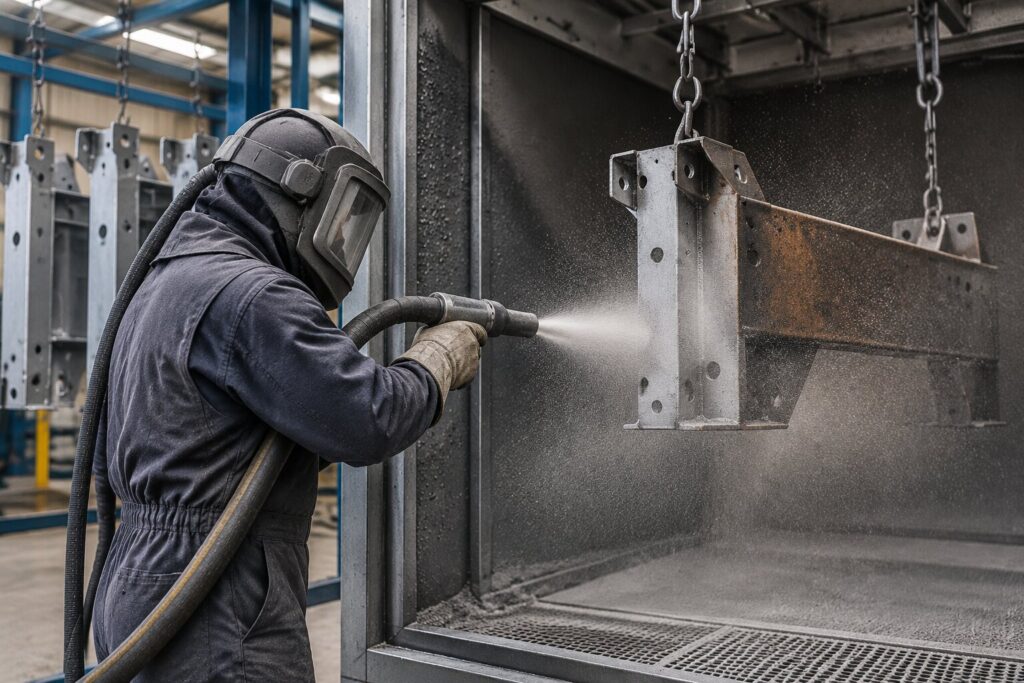
Shot blasting is a surface preparation process that fires small steel shot or grit particles at high velocity against a metal surface to remove rust, mill scale, old coatings and contaminants. It is the most effective way to prepare metal before powder coating, creating a clean, roughened surface profile that allows the coating to bond properly. Without adequate surface preparation, even the highest-quality powder coating will fail prematurely — making shot blasting one of the most important steps in the entire finishing process.
Key Takeaways
- Shot blasting removes rust, mill scale, old paint and surface contaminants from metal in seconds
- It creates a surface profile (roughness) of 25–75 microns, which is essential for coating adhesion
- According to NACE International (now AMPP), over 80% of coating failures are caused by inadequate surface preparation — not the coating itself
- Shot blasting is faster and more environmentally friendly than chemical stripping — no solvents, no acid waste
- Spraytech provides shot blasting as part of our surface preparation services from two facilities in Bishop’s Stortford
What Is Shot Blasting?
Shot blasting is a mechanical surface preparation method where abrasive particles — typically steel shot, steel grit or aluminium oxide — are propelled at high speed against a metal surface using either a blast wheel (centrifugal) or compressed air (pneumatic). The impact removes rust, mill scale, old coatings, weld spatter and other surface contaminants, leaving a clean, bare metal surface with a controlled roughness profile.
The process was originally developed for cleaning castings in foundries, but is now one of the most widely used surface preparation techniques across manufacturing, construction and metal finishing. In the UK, shot blasting is specified as a pre-treatment step on the majority of industrial and architectural powder coating projects.
Shot blasting is governed by international standards, most commonly ISO 8501-1, which defines cleanliness grades from Sa 1 (light blast cleaning) to Sa 3 (blast cleaning to visually clean steel). Most powder coating specifications call for Sa 2½ — near-white metal with no more than 5% residual staining.
How Does Shot Blasting Work? (Step-by-Step Process)
The shot blasting process follows four stages. Each stage is controlled to achieve the correct cleanliness grade and surface profile for the coating that will be applied.
Step 1 — Initial Inspection
The metal item is inspected to assess its condition — the type and severity of rust, the presence of old coatings (paint, galvanising, zinc spray), weld spatter, oil or grease contamination, and the base metal type (mild steel, cast iron, aluminium). This determines the correct abrasive type, blast pressure and exposure time.
Step 2 — Pre-Cleaning (If Required)
If the metal has heavy oil or grease contamination, it is degreased before blasting. Oil on the surface will contaminate the abrasive media and can become embedded in the surface profile during blasting, preventing the coating from bonding. Degreasing is done using solvent wipe, alkaline wash or vapour degreasing.
Step 3 — Shot Blasting
The item is placed in a blast cabinet or blast room. Abrasive particles are fired at the surface at speeds of 65–110 metres per second. The impact strips away rust, mill scale, old coatings and contaminants, exposing clean bare metal. At the same time, the abrasive particles create thousands of tiny peaks and valleys on the surface — this roughness (called the surface profile) gives the powder coating something to grip onto.
The surface profile is measured in microns. For powder coating, the ideal profile is typically 25–75 microns. Too smooth and the coating cannot anchor; too rough and the coating may not cover the peaks adequately, leading to thin spots and premature failure.
Step 4 — Post-Blast Cleaning and Coating
After blasting, loose dust and residual abrasive are removed from the surface using compressed air or vacuum extraction. The item must then be coated as quickly as possible — ideally within 4 hours — because clean, bare metal begins to oxidise (flash rust) when exposed to moisture in the air. At Spraytech, items move directly from our blast facility to our powder coating line to minimise this gap.
Why Is Shot Blasting Important Before Powder Coating?
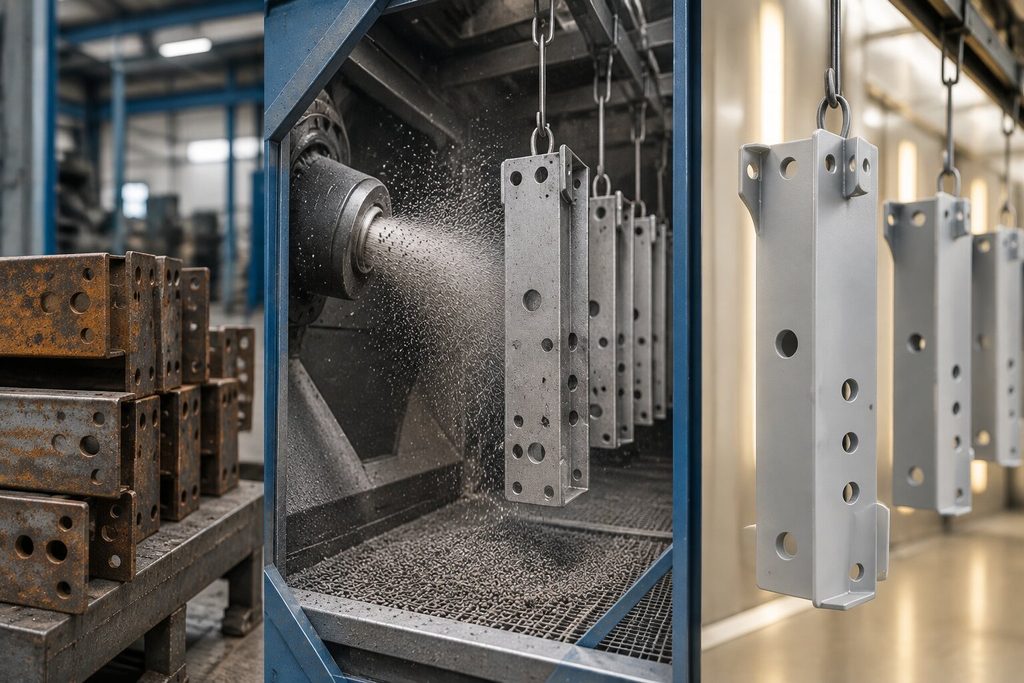
Shot blasting is important before powder coating because it directly determines how well the coating bonds to the metal — and therefore how long the finish will last. According to AMPP (formerly NACE International), the global authority on corrosion prevention, over 80% of premature coating failures are caused by inadequate surface preparation rather than defects in the coating itself.
Shot blasting achieves three things that no other preparation method matches simultaneously:
1. Removes contaminants completely — rust, mill scale, old paint, weld spatter, grease and oxidation are all removed in a single pass. Chemical cleaning can remove some of these, but not mill scale or heavy rust. Manual preparation (wire brushing, sanding) is inconsistent and far slower.
2. Creates the correct surface profile — the controlled roughness created by shot blasting gives the powder coating a mechanical key to grip onto. A smooth, untreated metal surface has a profile of 5–10 microns. After shot blasting, this increases to 25–75 microns — increasing the contact area between the metal and the coating by up to 400%.
3. Exposes bare metal for chemical bonding — when rust, mill scale and old coatings are removed, the pre-treatment chemicals (iron phosphate for steel, chromate-free conversion coating for aluminium) can react directly with the metal surface. This creates a chemical bond layer beneath the powder coating that dramatically improves adhesion and corrosion resistance.
What Abrasive Media Are Used in Shot Blasting?
Different abrasive types are used depending on the base metal, the level of contamination and the required surface profile:
| Abrasive Type | Material | Best For | Surface Profile |
|---|---|---|---|
| Steel shot | Spherical steel particles | General steel cleaning, medium profile | 25–50 microns |
| Steel grit | Angular steel particles | Heavy rust, mill scale, aggressive cleaning | 50–100 microns |
| Aluminium oxide | Aluminium oxide granules | Aluminium, stainless steel, delicate items | 25–50 microns |
| Glass bead | Spherical glass | Light cleaning, satin finish, thin metals | 10–25 microns |
| Garnet | Natural mineral | General purpose, moderate profile | 25–75 microns |
Steel shot and steel grit are the most commonly used media for structural steelwork and industrial components. Aluminium oxide is preferred when blasting aluminium to avoid ferrous contamination that could cause corrosion under the coating.
Shot Blasting vs Grit Blasting — What Is the Difference?
Shot blasting and grit blasting are often used interchangeably, but they refer to different abrasive shapes that produce different surface finishes:
Shot blasting uses spherical abrasive particles (steel shot, glass bead). The round shape produces a peened, dimpled surface profile. Shot blasting is less aggressive, removes material more slowly and produces a smoother profile. It is ideal for cleaning where a moderate surface roughness is required.
Grit blasting uses angular, sharp-edged abrasive particles (steel grit, aluminium oxide, garnet). The angular shape cuts into the surface, removing material faster and producing a sharper, more aggressive surface profile. Grit blasting is better for heavily rusted or contaminated surfaces, thick mill scale and situations where maximum coating adhesion is critical.
In practice, many metal finishing facilities — including Spraytech — use a blend of shot and grit to balance cleaning speed, surface profile and surface finish quality. The exact blend is adjusted based on the item being blasted and the coating specification.
What Items Can Be Shot Blasted?
Shot blasting can be applied to virtually any metal item that fits within the blast cabinet or blast room. At Spraytech, we regularly shot blast:
- Gates, railings and fencing — removing old paint and rust before recoating
- Structural steelwork — beams, columns, brackets and fabricated assemblies
- Architectural metalwork — balustrades, staircases, cladding frames and louvres
- Cast iron — radiators, fire surrounds, heritage components and decorative items
- Automotive parts — wheels, suspension components, subframes and brackets
- Manufacturing components — enclosures, frames, panels and production parts
- Garden furniture — chairs, tables, benches and planters
Items that should not be shot blasted include thin sheet metal (below 1mm), items with sealed cavities that cannot be cleaned internally, and non-metallic items. For thin or delicate items, glass bead blasting or chemical pre-treatment may be more appropriate.
How Much Does Shot Blasting Cost in the UK?
Shot blasting costs depend on the size of the item, the level of contamination and whether the item is being blasted as a standalone service or as part of a powder coating job. General UK price guides for domestic items:
- Pair of garden gates: £30–£60 (blast only)
- Set of 4 garden chairs: £25–£50
- Single alloy wheel: £15–£30
- Railing section (per metre): £8–£15
- Bike frame: £20–£40
When shot blasting is combined with powder coating, the cost is typically included in the overall coating price. Contact Spraytech with photos and dimensions for an accurate quote.
Frequently Asked Questions
What is the purpose of shot blasting before powder coating?
Shot blasting removes rust, old paint, mill scale and contaminants from the metal surface and creates a roughened surface profile that allows the powder coating to bond securely. Without proper shot blasting, the coating may peel, chip or fail prematurely — over 80% of coating failures are traced back to inadequate surface preparation.
Is shot blasting the same as sandblasting?
Shot blasting and sandblasting are both abrasive blasting processes, but they use different media. Traditional sandblasting used silica sand, which is now largely banned in the UK and EU due to the health risk of silicosis (a serious lung disease caused by inhaling silica dust). Modern shot blasting uses steel shot, steel grit, aluminium oxide or garnet — all of which are safer and more effective than sand.
Can aluminium be shot blasted?
Yes, but aluminium must be blasted with non-ferrous media such as aluminium oxide or glass bead. Using steel shot or grit on aluminium would embed ferrous particles in the surface, which can cause corrosion beneath the coating. At Spraytech, we use dedicated aluminium oxide media when blasting aluminium components.
How long does shot blasting take?
Most domestic items can be shot blasted in 15–45 minutes. Larger industrial components or heavily rusted items may take longer. The time depends on the size of the item, the severity of contamination and the abrasive type being used.
Does shot blasting damage the metal?
When done correctly, shot blasting does not damage the metal. The abrasive type, pressure and exposure time are controlled to remove contaminants without removing significant base material. However, very thin metals (below 1mm) can be warped by aggressive blasting, which is why lighter media such as glass bead is used for delicate items.
Can shot blasting remove galvanising?
Yes. Shot blasting can remove zinc galvanising from steel surfaces. This is sometimes required when the galvanised layer has degraded and the item needs to be re-coated. However, blasting galvanised surfaces requires specific precautions due to zinc dust, and the blasted surface must be treated before coating to avoid adhesion issues.
Do I need shot blasting if my item is new steel?
Yes, in most cases. New steel from the mill has a layer of mill scale — a hard, bluish-grey iron oxide that forms during hot rolling. Mill scale looks clean but is loosely bonded and will eventually flake, taking any coating applied over it with it. Shot blasting removes mill scale and creates the surface profile needed for a durable coating.
Conclusion
Shot blasting is the foundation of every durable powder coating finish. Without it, coatings fail — not because the powder was wrong, but because the surface underneath was not properly prepared. Over 80% of coating failures trace back to this single step.
At Spraytech, shot blasting is a standard part of our preparation process for industrial, architectural and domestic powder coating work. We operate dedicated blast facilities at both our Bishop’s Stortford sites, with capacity for items up to 10 metres in length.
If your metalwork needs shot blasting — whether as a standalone service or before powder coating — get in touch for a quote.